


Beware of unofficial ticket sellers! This is the only official website to purchase tickets for Sedlec Bone Church. Avoid third-party resellers charging inflated prices.

Tickets to Sedlec sights can only be purchased online or at the Sedlec Information Centre, 279 Zámecká Street.
9 AM - 4 PM
150 CZK / adult

The 800-year-long story of the Sedlec Cathedral is full of ups and downs. Built at the turn of the 13th and 14th centuries in an incredible 30 years, it was burned down by the Hussites in the 15th century in a single night. Even the surviving ruins amazed with their grandeur, earning the nickname Splendissima Basilica. When the genius architect Jan Blažej Santini Aichel arrived in Sedlec in the 17th century, the cathedral literally rose from the ashes like a Phoenix. Santini breathed new life into the 300-year-abandoned ruins by maintaining the simple Gothic lines and combining them with ornate Baroque elements. This seemingly incongruous symbiosis, called Baroque Gothic, is unique in the world, which is why the cathedral was inscribed on the UNESCO World Heritage list in 1995. Though in the shadows, it remains radiant, full of light, hope, and the stories of previous generations etched into the unique architecture of this still-functioning parish church.
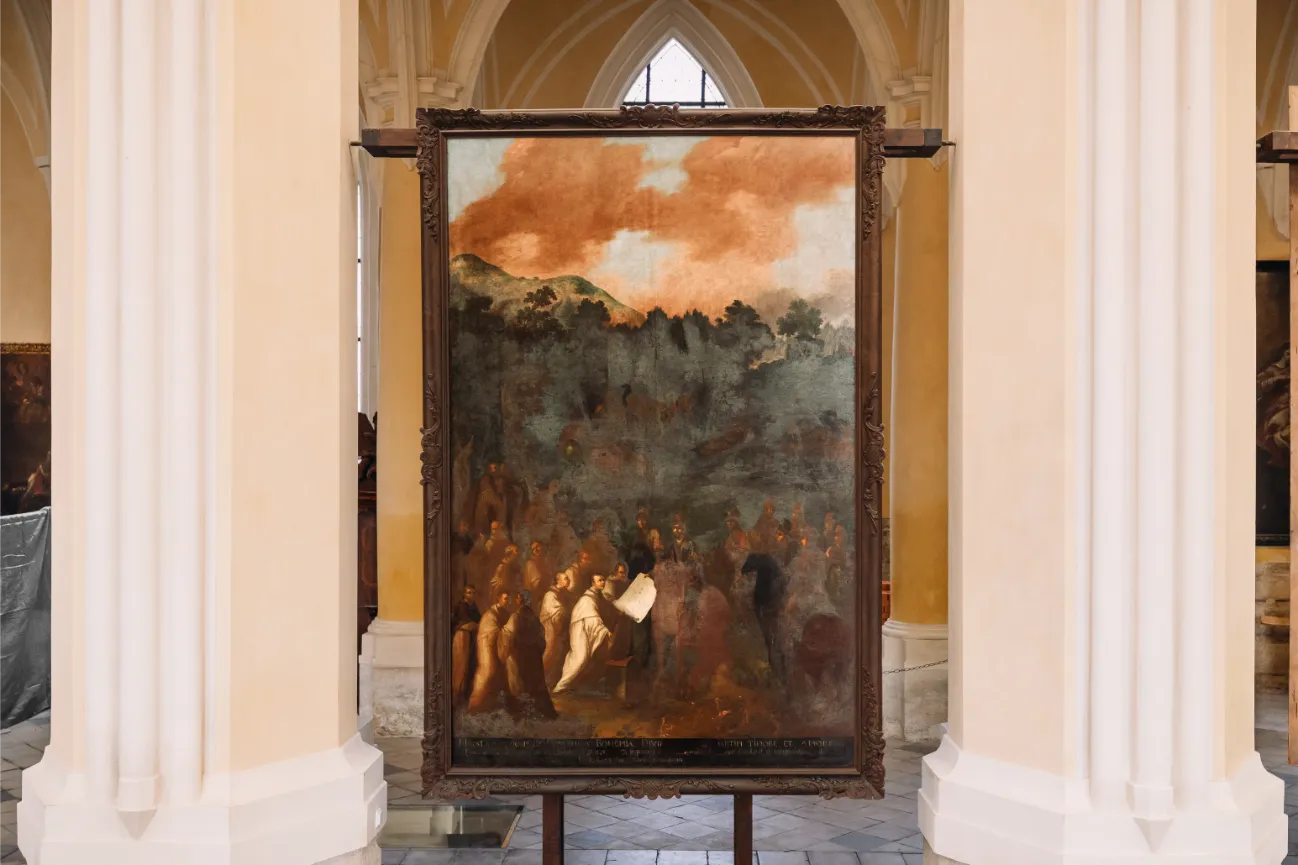
The founding of the Sedlec Abbey by an unknown author, beginning of the 18th century. The founding of the Sedlec Abbey coincided with the arrival of twelve Cistercian monks from Waldsassen Abbey in Bavaria sometime after 1142. The painting depicts the ceremonial handing over of the monastery’s founding charter, which was written around 1145. A facsimile of the founding charter can be viewed in the treasure chamber (point of interest No. 7). For more information about the Cistercian Order, see point of interest No. 16.
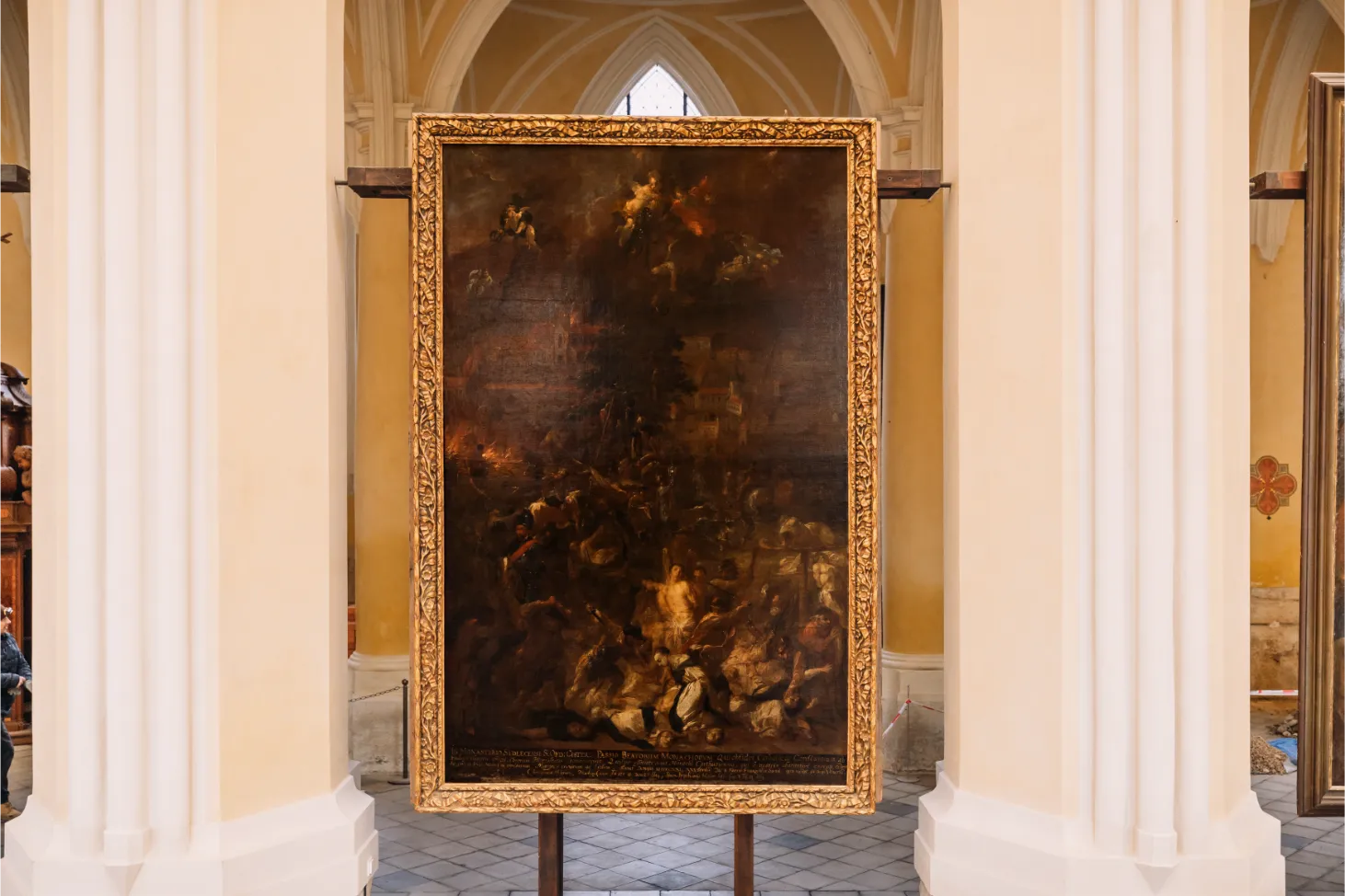
The burning of the Sedlec Abbey by Michael Leopold Willmann, beginning of the 18th century. The painting refers to the grim night of 24th to 25th April 1421, when the Sedlec Abbey was burnt down by the Hussites. The monks were murdered, the monastery looted, and the cathedral set on fire. After the destruction of the monastery, life returned to Sedlec only in the first half of the 16th century. The remains of the cathedral awaited restoration for even longer – almost three hundred years.
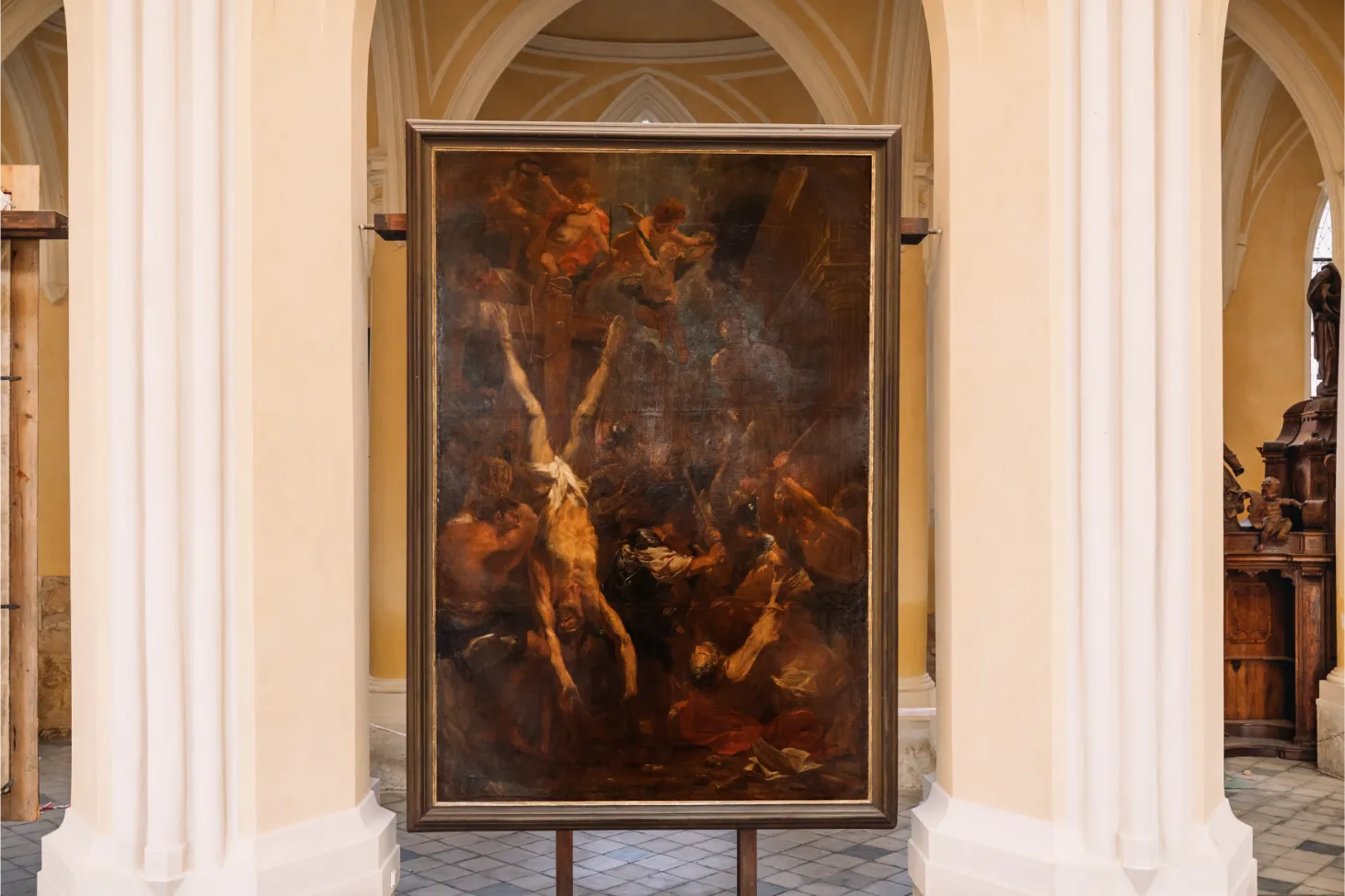
The Passion of Saints Philip and James by Michael Leopold Willmann, beginning of the 18th century
Michael Leopold Willmann (1630–1706)
Michael Leopold Willmann studied painting with his father Peter Willmann and became one of the most important Baroque painters
in Central Europe. Around 1650 he left for the Netherlands, where he found inspiration mainly in the work of Rembrandt and Rubens.
After his return, he did not settle in Prague, probably because of strong competition from Karel Škréta, and around 1660 left for
Poland. There he converted to the Catholic faith and then spent most of his years in the Lubiąż Abbey. He started working for the
Sedlec Abbey near the end of his life, after meeting the abbot Jindřich Snopek.
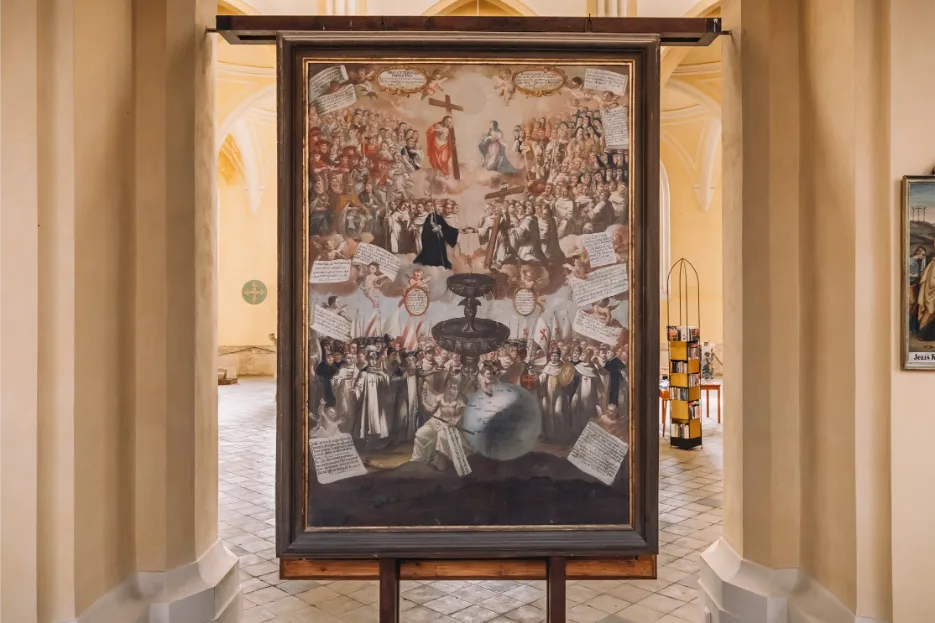
The Founding of the Cistercian Order and its spread around the world by an unknown author, beginning of the 18th century.
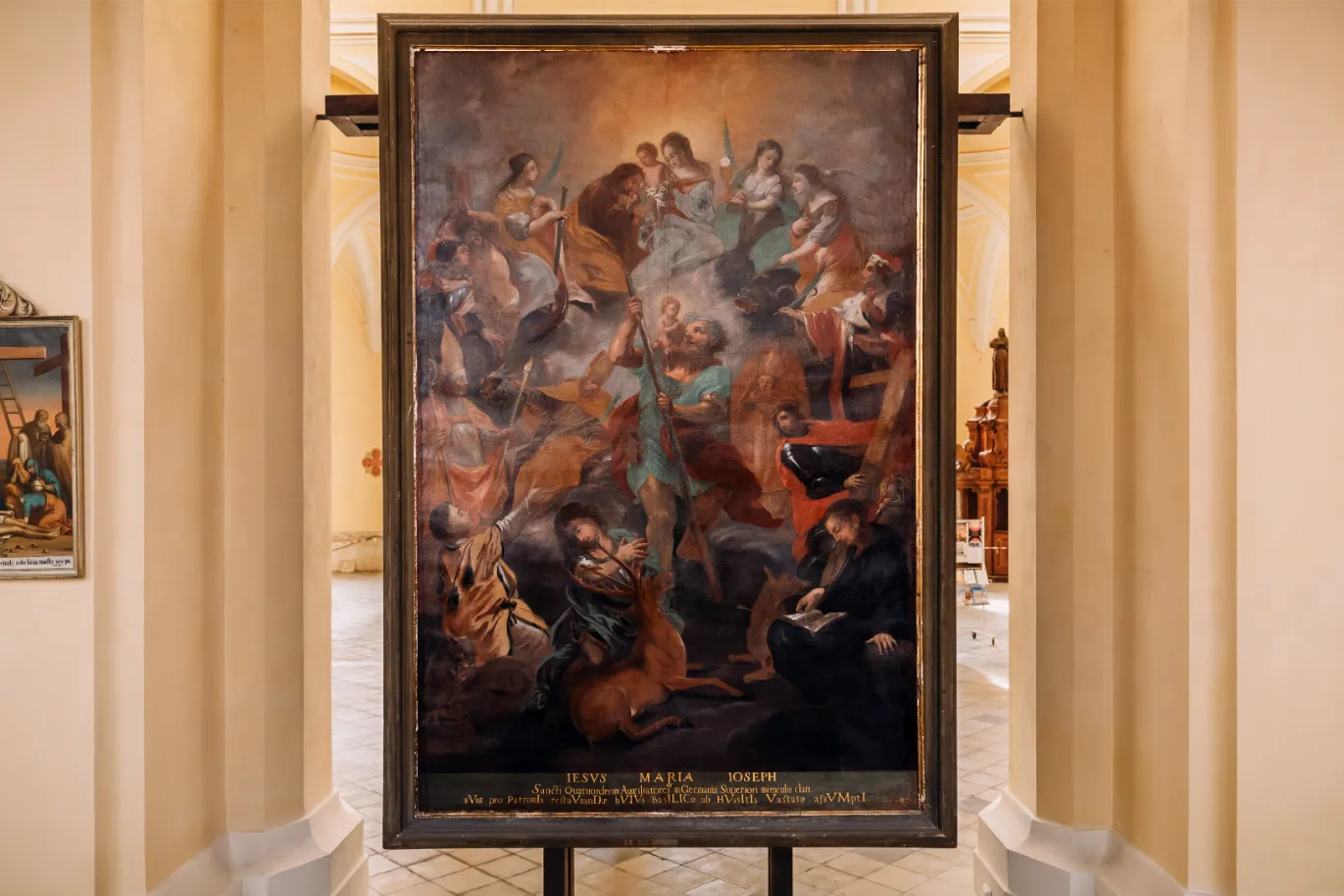
The Fourteen Holy Helpers by an unknown author, beginning of the 18th century.
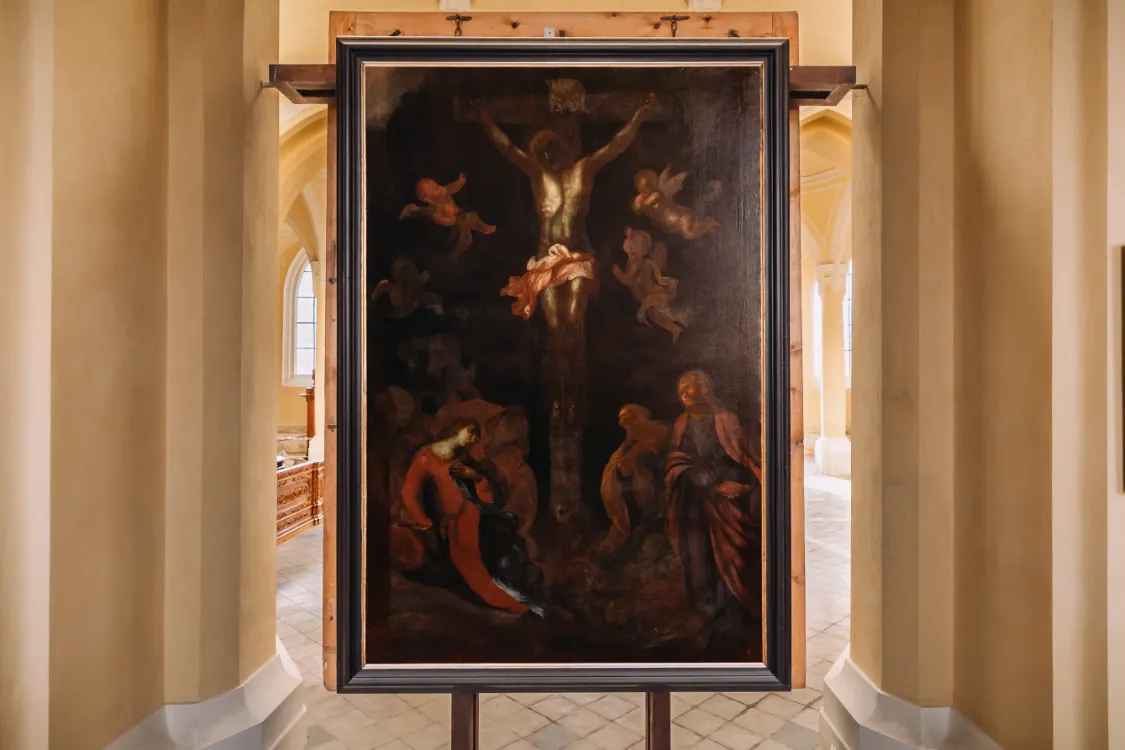
Crucifixion by an unknown author, beginning of the 18th centur.
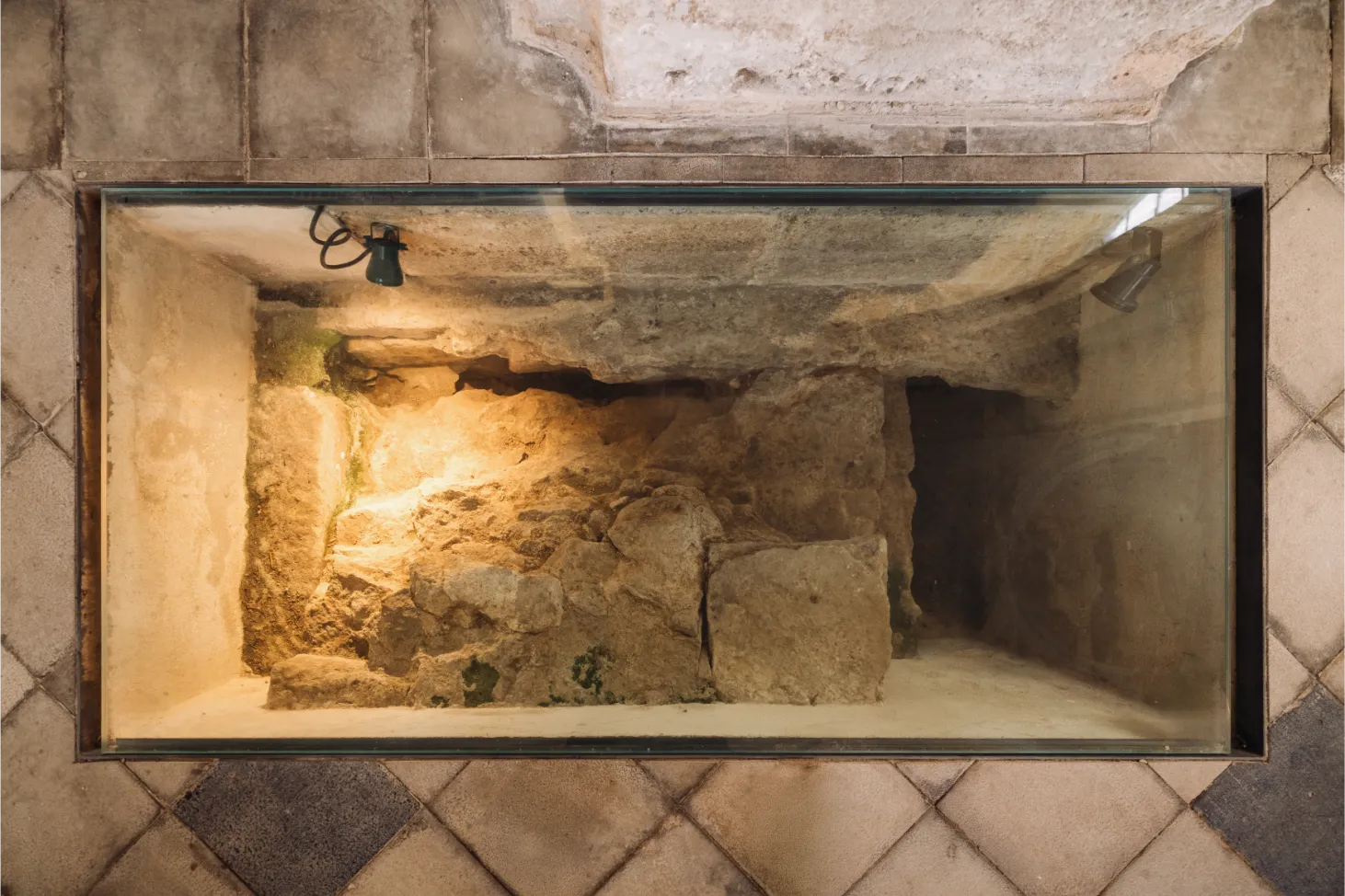
Archaeological probe into the foundations of the original Romanesque church
A Romanesque church stood in the place of today’s Gothic cathedral in the years 1142–1148. A fragment of its foundations was
uncovered during the restoration of the cathedral in 2008. However, the whole footprint of the original building could not be determined,
because the masonry materials from the 12th century were reused during the grandiose Gothic reconstruction in the 14th century. It took
place at the time of the greatest boom of the Cistercian monastery, which became rich thanks to silver mining on its lands. The cathedral
was erected in a mere thirty years (1290-1320), an exceptionally short time, and was the largest sacral building in the territory of
present-day Czechia. The abbot at the time was Heidenreich († 1320), a close friend of King Wenceslaus II. At the king’s request, he
travelled to the Holy Land, from where, as legend has it, he brought a handful of dirt, which he scattered in the cemetery at Sedlec. This
made it a popular final resting place.
In the 12th century, there were two churches on the grounds of the Cistercian monastery in Sedlec: The first was the Church of the
Assumption of the Virgin Mary, a fragment of whose foundations you can see right here. This church served the monastery’s monks.
And then there was the Church of St Philip and St James, which was for lay brothers, commonly referred to as ‘conversi’. The latter
stood in today’s Castle Street [Zámecká ulice] until 1817, when it was demolished. However, remnants of its perimeter walls are still
discernible behind the building of today’s butcher’s shop.
So why is this place called Sedlec? The legend about the foundation of the monastery tells about a nobleman named Miroslav, who
fell asleep here with a horse saddle under his head. During his sleep, a bird with golden wings—an angelic messenger— flew into his
open mouth and told him in a dream that he should have a monastery built on this very spot. Miroslav did so and donated vast tracts of
land to the Cistercian Order. Its name allegedly refers to the saddle (= ‘sedlo’ in Czech) on which Miroslav rested.
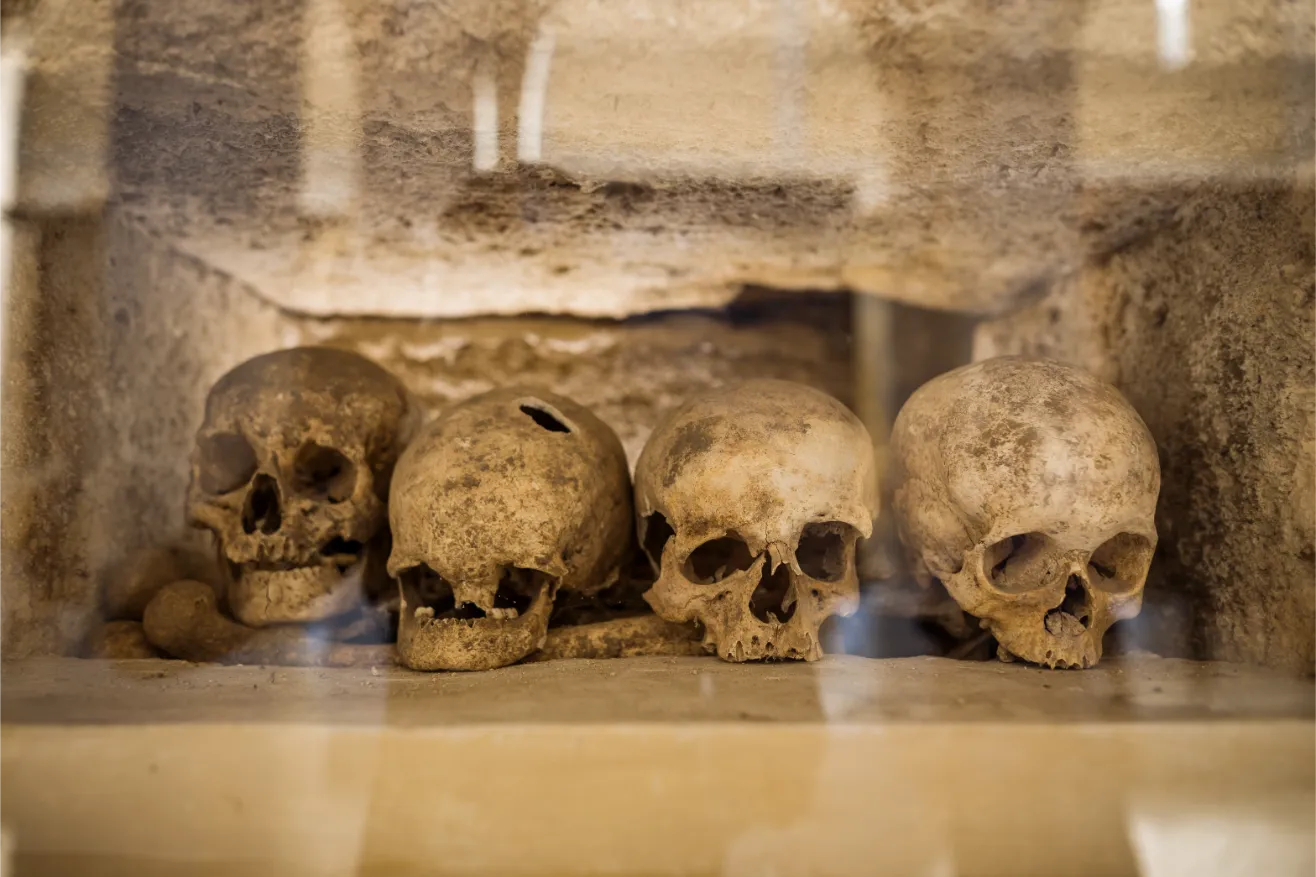
Remains of Cistercian monks
These are the remains of monks murdered during the Hussite Wars. They were probably found during the restoration of the cathedral in
the 18th century.
The Hussites burned down the Sedlec Cathedral on 25 April 1421. A chilling, although untrue, legend has it that the commander Jan
Žižka himself, impressed by its magnificent beauty, strictly ordered his soldiers to spare the building before setting off for the nearby
town of Čáslav. However, one of Žižka’s men disobeyed the order and set the cathedral alight. Seeing the smouldering ruins of the
cathedral upon his return to Sedlec, Žižka burst into a terrifying fit of rage. ‘Let whoever set the cathedral on fire come forward. He will
get enough silver to last him a lifetime!’ The ardent Hussite came forth and Žižka fulfilled his promise, but in his own way. He ordered
some silver to be melted and then poured it down his throat.
However, what actually happened was slightly different: The Hussites, during their horrific rampage, completed the murder of the
Cistercians by herding the surviving monks into the cathedral and setting fire to its roof. The roof and the vault collapsed, burying the
monks under the ruins. The remains of the monks were apparently found during the restoration in the early 18th century. They were then
placed in one of the niches in the side aisle, formerly used for storing liturgical implements.
Life returned to the burnt-down monastery no sooner than thirty years after the Hussite rampage. For a long time, however, no-one
mustered the willpower to also resurrect the cathedral. All that remained of it were the sad, dilapidated remnants of the outer walls with
blocked-up window openings and trees growing inside the former nave. Even so, however, the church still gave a grand impression.
During a visit to the cathedral’ ruins, the prominent 17th-century historian Bohuslav Balbín remarked: ‘splendissima basilica’, meaning
‘the most splendid church’.
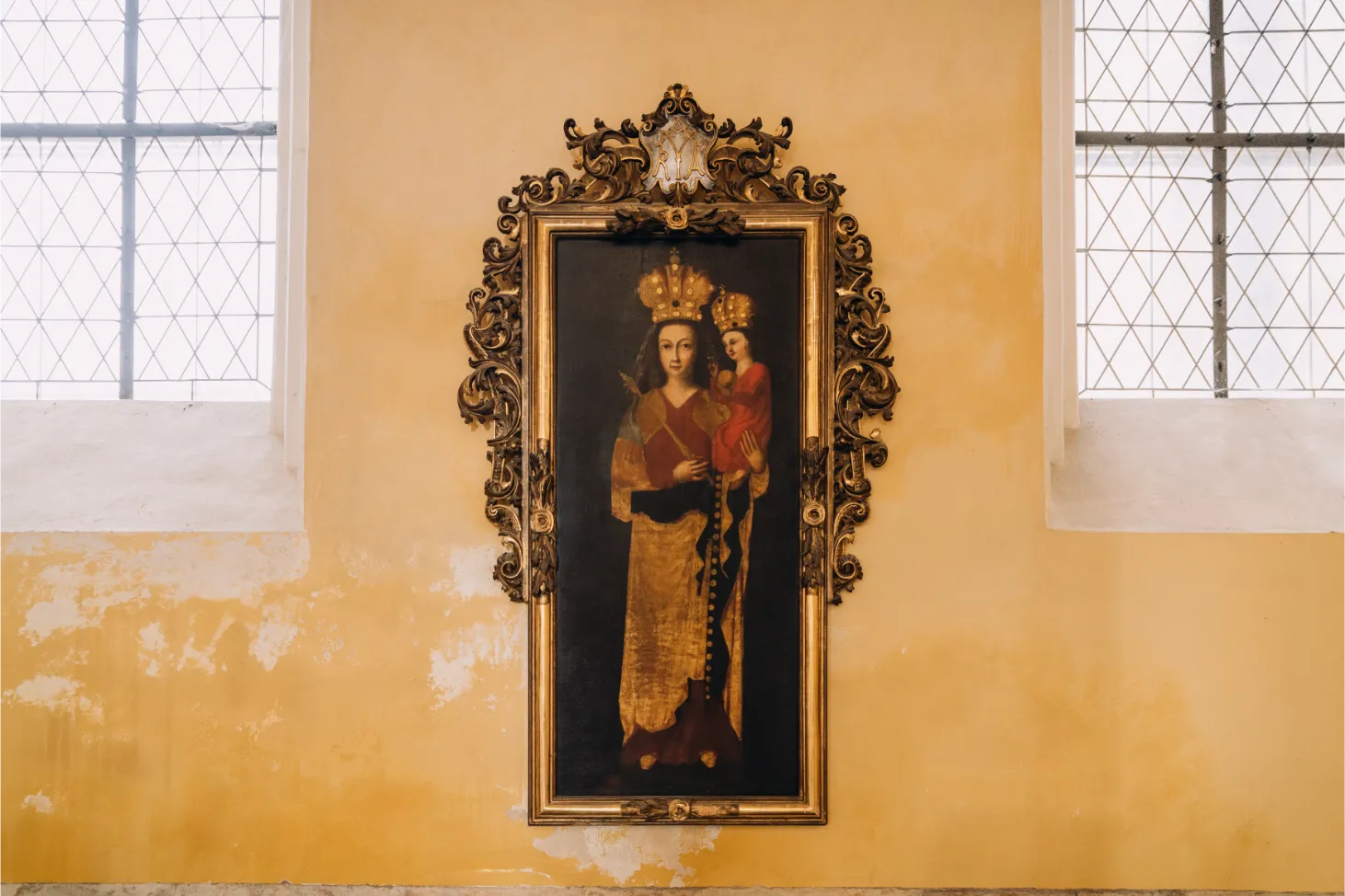
Madonna of Žarošice
This Baroque painting by an unknown author refers to the Marian pilgrimage site Žarošice near the town of Břeclav in Moravia.
Many a miracle is associated with the statue of the Virgin Mary in Žarošice, the most famous of which speaks about the conversion of a
Turkish pasha to the Christian faith. In the 16th century, almost the whole of Moravia was plundered in raids by nomadic Turks. Their
wrath did not spare the village of Žarošice, which was raided in 1529. A haughty Turkish pasha rode his horse into the church of
Žarošice and when he saw the statue of the Mother of God, he began to mock it. As soon as he saw tears falling from the statue’s eyes,
he himself started to sob and lost his eyesight. This, of course, frightened the Turk, which made him promise to a priest that if he
regained his vision, he would become a faithful Christian. So he began to study the Bible and recovered his sight after he got baptized.
The legendary Turk settled down in Žarošice as a hermit and ministered to the Virgin Mary until his death. At his request, he was buried
in the Marian shrine.
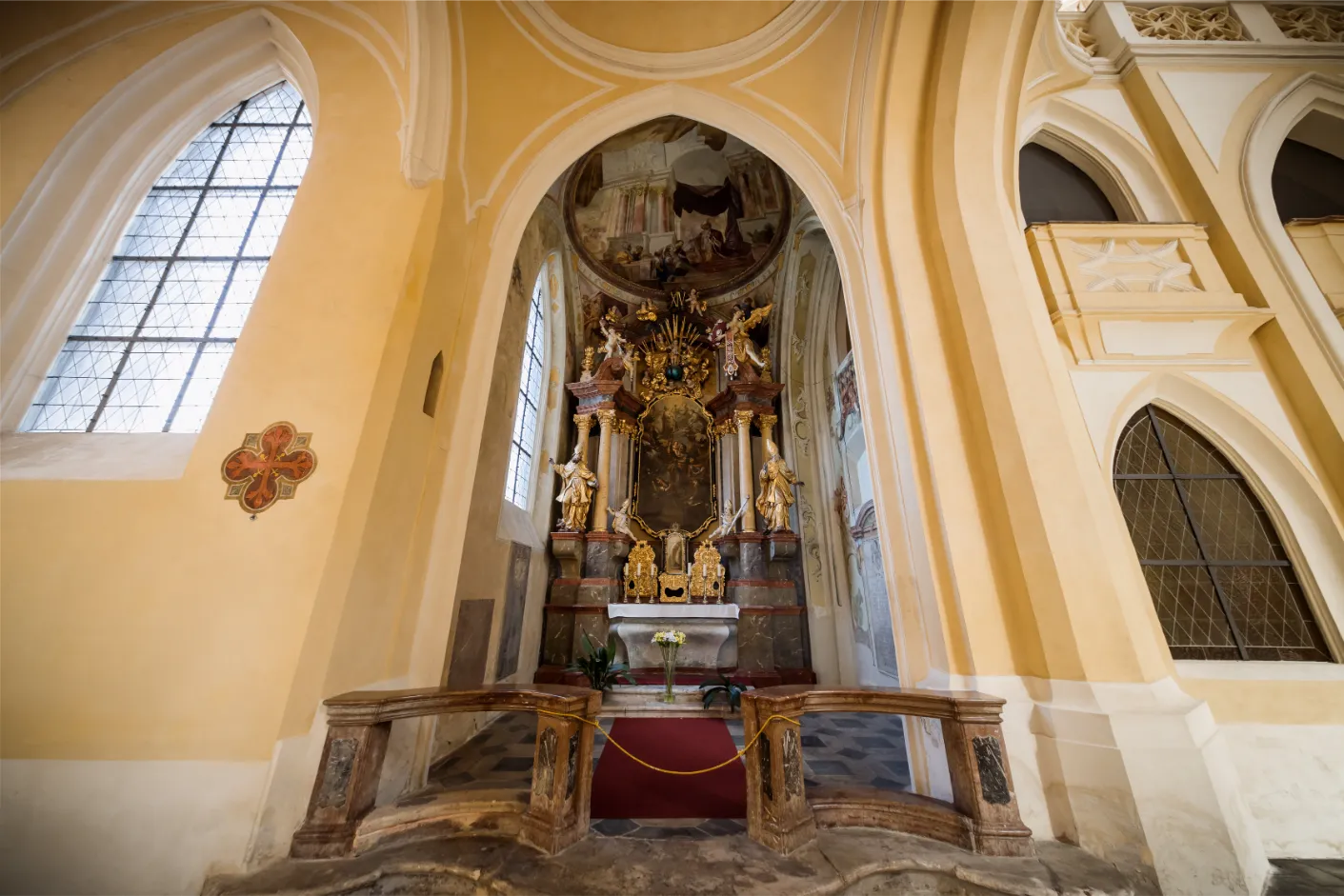
Chapel of the Fourteen Holy Helpers The cult of the Fourteen Holy Helpers originated in 14th-century Rhineland, probably in connection with the epidemic later known as the
Black Death. It venerates fourteen saints whose intercession is supposed to be particularly effective against various diseases. Their cult
came to Sedlec from Bavaria. The Chapel of the Fourteen Holy Helpers was where the first attempts were made to rebuild the cathedral
after the Hussite wars. This is evidenced by the Renaissance-style fresco in the left front corner of the chapel. In 1685, Jindřich Snopek
became the abbot of the Sedlec Abbey and managed to raise the funds for the restoration of the cathedral. The restoration was
extensive and took ten years (from 1699 to 1709), and the abbot Jindřich Snopek did not live to see its completion. His tombstone is
located on the right side of the chapel and bears the inscription ‘Restaurator Magnificus’, meaning ‘Great Restorer’. That the Abbot
Snopek is indeed buried there has been confirmed by an archaeological survey conducted in 2025.
Abbot Jindřich Snopek (1651–1709)
He came from southern Bohemia and was raised in very modest circumstances. Jindřich joined the Cistercians as a young man, and his
superiors soon noticed his extraordinary abilities and great diligence, as evidenced by his rapid ‘career’ rise. First, he became a prior (or
deputy abbot). Later he was sent to lead the St. Bernard’s College in Prague, where young Cistercians were educated. Finally, at the
age of only 35, Snopek became the abbot of the monastery in Sedlec. After more than 280 years that the Sedlec Cathedral stood in
ruins, he took the decision to have it repaired. He scraped together enough funds, managed to hire workers, and invited the very best
artists to take part in the restoration. With almost crazy courage, after only two years of cooperation, Jindřich Snopek dismisses the long-
established Prague builder Bayer and hires in his place a 25-year-old young man – Jan Blažej Santini-Aichel. Despite the vast age
difference between them, they share the vision that the ‘old’ Gothic and the ‘new’ Baroque could live in symbiosis.
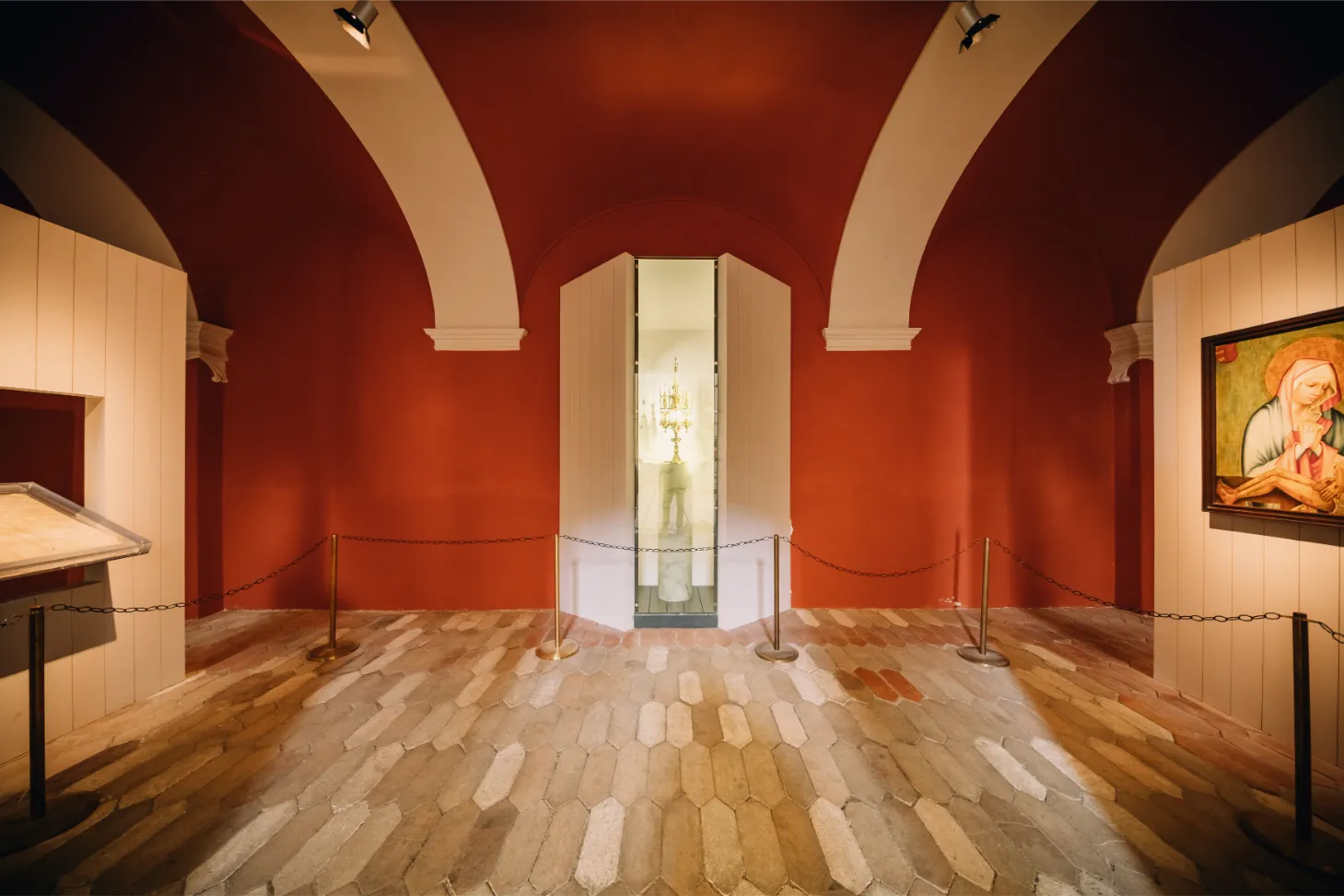
Treasure chamber
The cathedral’s treasure chamber holds one of the most valuable jewels in Czechia – the Sedlec Monstrance. It is probably the oldest
preserved Gothic monstrance in the world. It was made before 1389 by the Parléř workshops, commissioned by the Archbishop Jan of
Jenštejn of Prague, originally for the now-defunct Church of St Philip and St James in Sedlec. Shortly after its manufacture, the Sedlec
Monstrance, along with other valuables, had to be transported to Austria to be saved from plundering Hussites. It has been returned to
Sedlec only in 2011. The monstrance weighs 4.7 kg, measures 97 cm and is made of engraved gold-plated cast silver.
Monstrances are liturgical vessels used to display the Blessed Sacrament – the sacramental bread known as the host, which Christians
believe is transformed into the Body of Christ. A monstrance containing a consecrated host is used for adoration—the silent veneration
of Christ present in the Blessed Sacrament—and for the ritual blessing known as Benediction. It is also carried in Eucharistic
processions, for example on the Feast of Corpus Christi.
To the left of the entrance to the treasure chamber is a facsimile of the founding charter of the Sedlec Abbey, the original of which is
deposited in the National Museum. On the right is a copy of a scene from an altarpiece of an extraordinarily rare Gothic panel altar in the
Church of St Lawrence in the nearby village of Církvice.
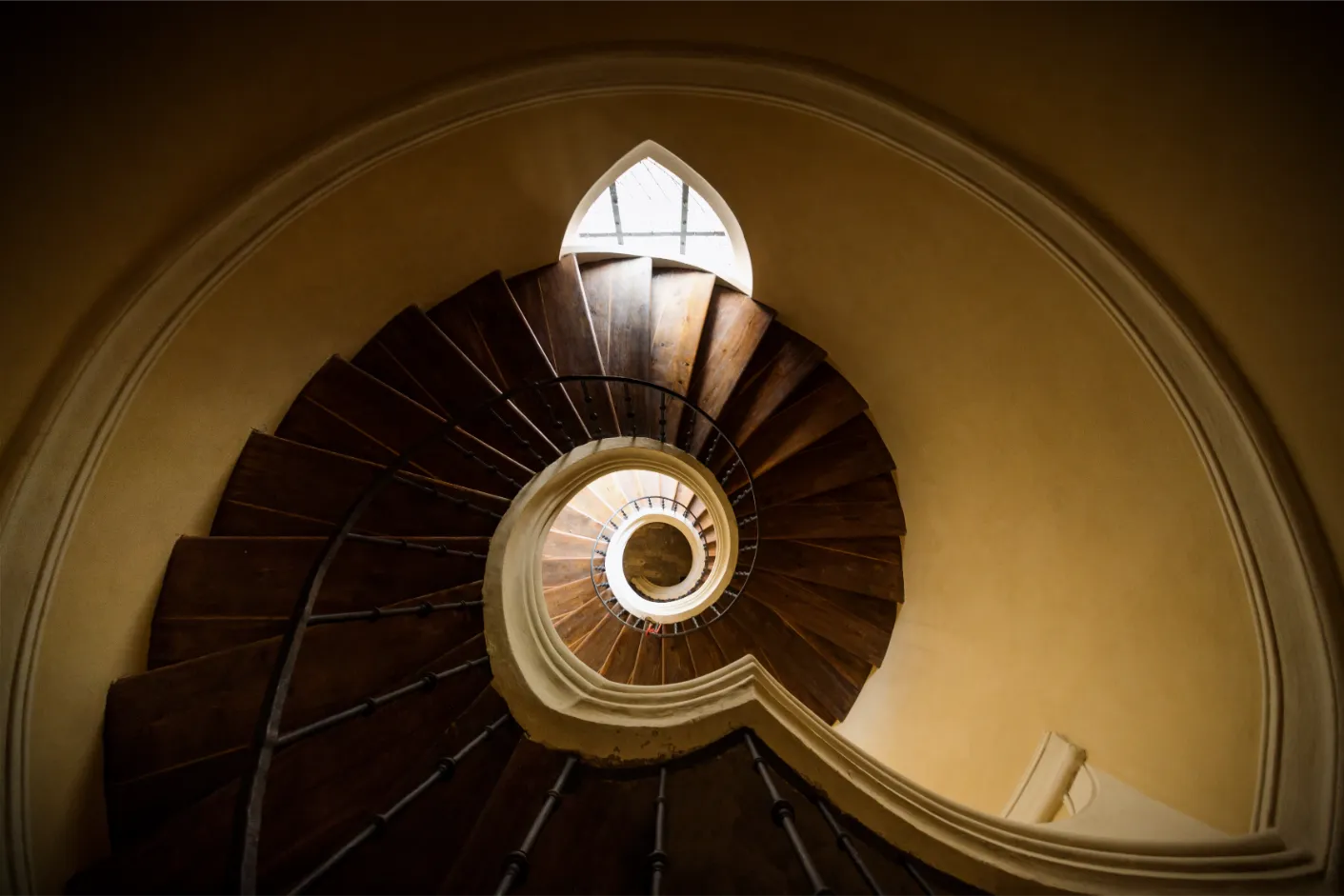
Santini-Aichel’s self-supporting staircase
Please walk up the staircase to the first floor.
It was during the restoration of this cathedral that Santini-Aichel developed for the first time his extraordinary talent to its full extent.
Influenced by his inspiration gained in Italy, he managed to combine original Gothic elements with then-modern Baroque ones into a
unique architectural whole. He also used original structural elements, such as the so-called Bohemian cap. It is a low, rounded vault
without a distinctive apex. This type of vault is used to arch the side aisles of the cathedral.
This staircase also deserves special attention, as it lacks the usual central column characteristic of the time. It is self-supporting and
anchored only in the perimeter wall—a bold, technically admirable and aesthetically perfect solution.
Jan Blažej Santini-Aichel (1677–1723)
This important Czech architect of Italian origin became famous for his unique style referred to as Baroque Gothic. He was only 25 when
he was invited to take part in the restoration of Sedlec Cathedral, and it was here that his unique inventiveness and talent fully shone
through for the first time. During his 23-year career as a prolific draughtsman, he designed approximately seventy sacred, palatial, and
agricultural buildings. He created spaces with excellent acoustics and extraordinary lighting characteristics. Other important monuments
created by Santini-Aichel include the Pilgrimage Church of St John of Nepomuk at Zelená Hora in Žďár nad Sázavou, the Plasy
Monastery, the Karlova Koruna Château in Chlumec nad Cidlinou and the Monastery Church of the Assumption of the Virgin Mary in
Kladruby.
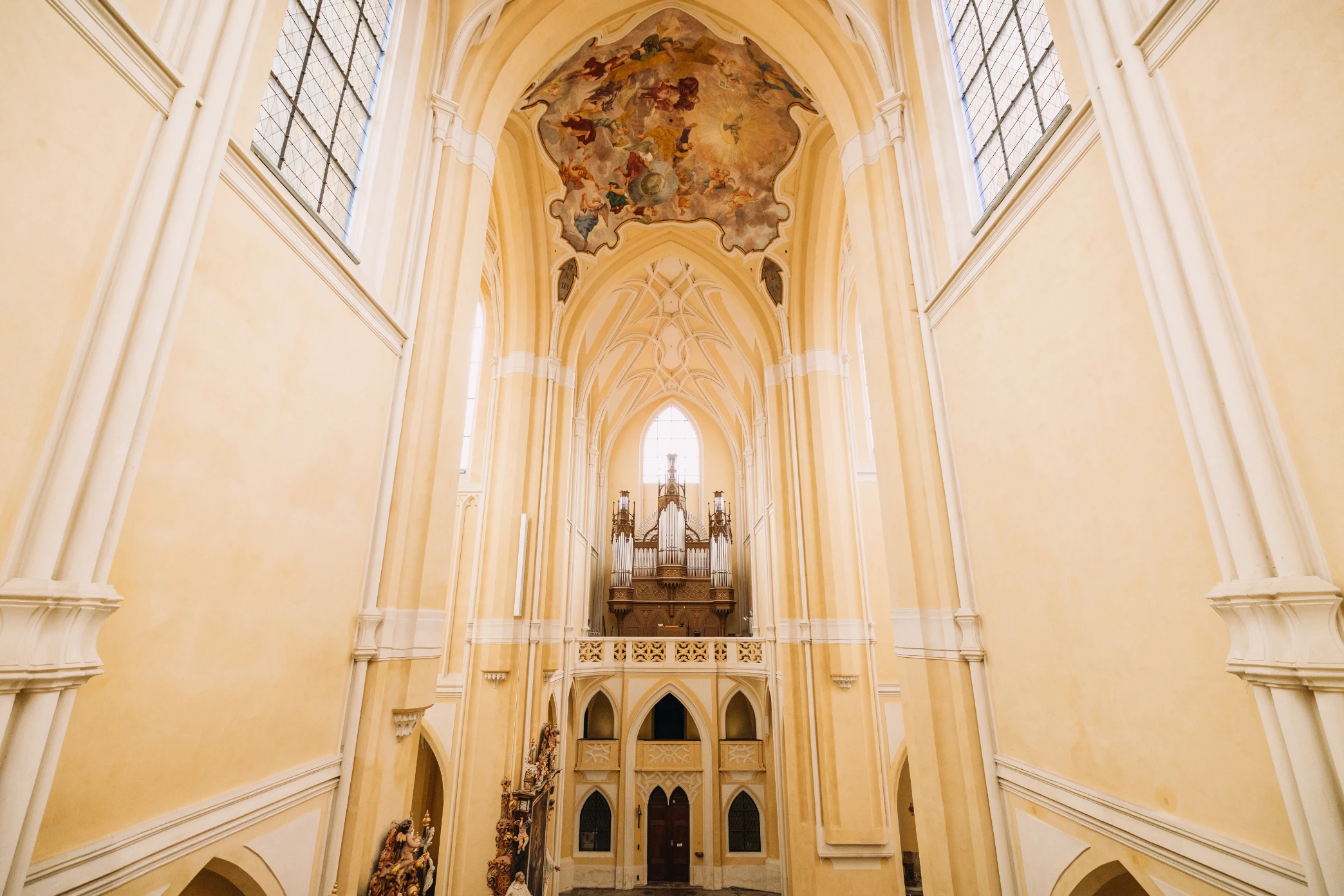
1st floor: Transept
The Sedlec cathedral is built in the shape of a cross. On the opposite side is a restored pipe organ built at the beginning of the 20th
century with a case crafted by Josef Melzer, an organ builder from Kutná Hora. On the back wall behind you is the altarpiece of the
Assumption of the Virgin Mary by Josef Bergler Jr from 1803, which was intended as a replacement for the original painting by Petr
Brandl, now in Vysoké Mýto. The painting depicts the mystery of the Christian faith that gave the name to this church, the Assumption of
the Virgin Mary. The painting depicts the Virgin Mary, who, according to lore, passed at the moment of her death, with both her soul and
body, into eternal bliss.
The restoration of the cathedral at the beginning of the 18th century left the Cistercians of Sedlec financially ruined. Its last abbot, Xaver
Freisauff, completed the disaster in 1764 by taking all remaining valuables and cash and fleeing to Hildesheim in Germany. The
monastery was abolished by Joseph II in 1783. Its monks had to move to other monasteries and the Cistercian property in Sedlec was
sold off in public auctions. This is also how the altarpiece of the Assumption of the Virgin Mary by Petr Brandl found itself in the town of
Vysoké Mýto. The extensive grounds of the former monastery, including the Church of All Saints with its ossuary, ended up in a public
auction, too. The land was bought by the Schwarzenberg family, which also took over the patronage of the Sedlec ossuary. The convent
building, where the monks lived, got sold to a tobacco company, and the cathedral, for a while, became a warehouse, before the church
regained its use in 1806.
Pass through the wooden door further into the attic.
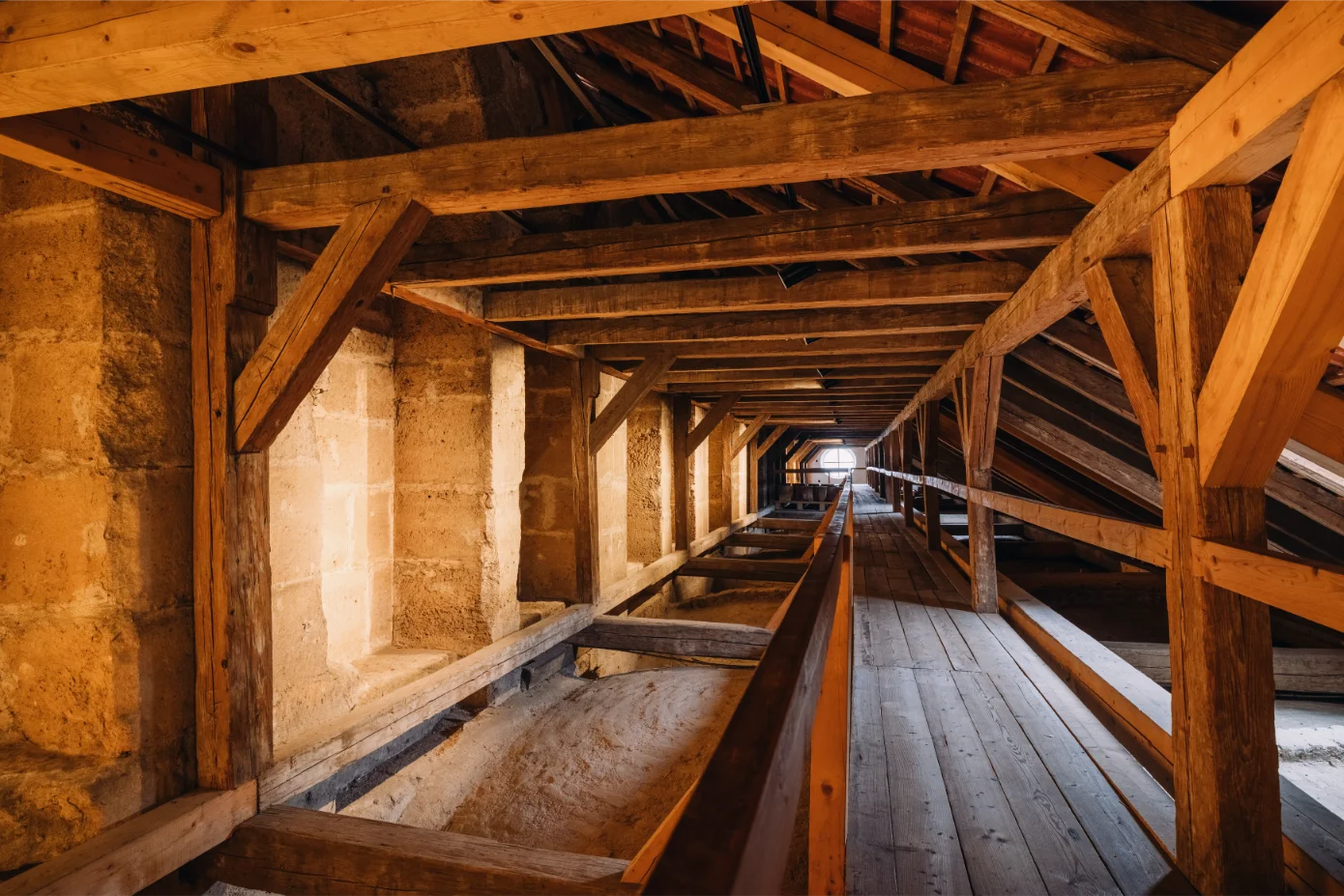
On the right next to the entrance is a Gothic staircase, which led directly into the monastery before the cathedral was burned down.
According to legend, Abbot Jacob used it to escape the Hussite siege with the precious Sedlec Monstrance.
Sedlec Cathedral underwent extensive renovation in 2000-2009 including the repair of the roof and its timber trusses. (Some of its
beams are still original and some have been partially spliced together with new wood). During the repairs, it also had to be ensured that
the walls of the cathedral would not collapse, which entailed raising part of the roof over the area to be repaired and replacing the cross-
beams.
Visible under the footbridge are the aforementioned vaults by Santini-Aichel referred to as Bohemian caps. In their construction, bricks
were briefly immersed in water to ensure that they are as dry as possible under the surface to allow them to absorb water from the
mortar used to bond the bricks together. After each brick was stuck to the others, it had to be held in place for about five minutes until a
firm bond formed. The vault is reinforced from above by a structure referred to as a brick belt.
Today, the attic also serves as a gallery holding exhibitions of contemporary art.
Continue to the end of the footbridge and enter the choir loft through the wooden door.
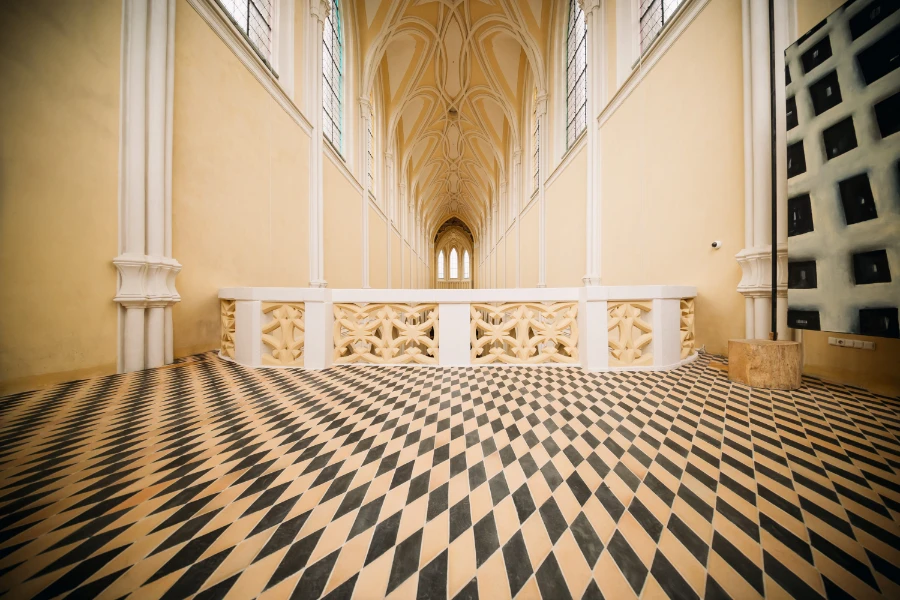
1st floor: Choir loft at the west front of the church
The choir is usually where the church organ is placed, but in the cathedral of Sedlec this was not possible for two reasons: One of them
is the window behind you. With a window this large, any instrument would suffer from fluctuations in heat and light passing through it.
The other reason is the specific acoustics of the space, characterized by very long reverberation.
So why is this church called a cathedral? In the case of the cathedral in Sedlec, it is for architectural reasons: In architecture, the
term ‘cathedral’ refers to a type of Gothic multi-aisled church with a gallery around the perimeter of the presbytery (see point of interest
No. 12). Therefore, the Sedlec Cathedral is more precisely described as a cathedral-type church. Only four such churches still exist
today in Czechia: Sedlec Cathedral, the Cathedral of St Barbara in Kutná Hora, the Cathedral of St Bartholomew in Kolín and St Vitus
Cathedral in Prague.
The Sedlec Cathedral is 92 metres long, 29 metres wide and 28 metres high, with 35 supporting pillars and 32 Tuscan columns propping
up the side aisles. The walls of the nave are reinforced with arcades on the inside. The cathedral therefore does not need an external
support system, as we see, for example, at the Cathedral of St Barbara. The cathedral is amply illuminated by 106 windows, the largest
of which is located in the choir area behind you. It is fourteen metres tall and, on the day of the equinox, casts a circle of sunlight directly
onto the main altar.
Please walk back through the attic and transept. After descending the staircase, turn left to enter the chapel gallery.
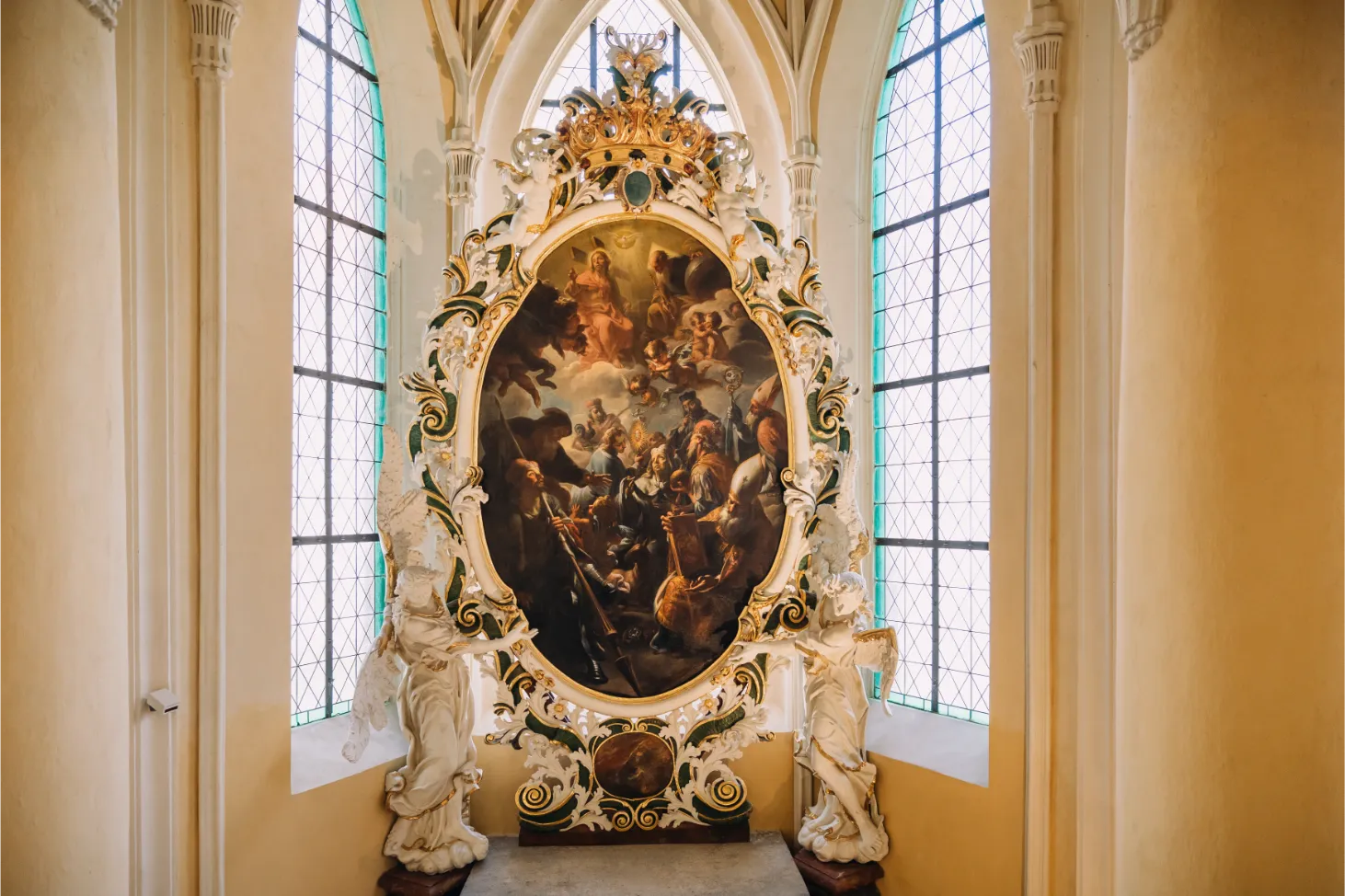
Painting of the Patron Saints of the Land of Bohemia by Petr Brandl,, from around 1728 – the Baroque painter included a
depiction of himself in the painting as the figure in the middle next to the sun-shaped monstrance.
Petr Brandl (1668–1735)
Petr Brandl was probably the most influential High Baroque painter in the Czech Lands. He studied this painting style under the
Prague court painter Christian Schröder. He was very well paid for his works but always squandered the money and was frequently
in debt. In 1728, Brandl was held under house arrest in Hradec Králové for not repaying his loans. He was finally released from it
thanks to the abbot of the Sedlec Abbey, who offered him a job. Brandl stayed for nearly two years in Sedlec, during which time he
created four paintings for the cathedral. The most remarkable of them, an altarpiece of the Assumption of the Virgin Mary, was sold
to the town of Vysoké Mýto after the monastery was abolished. Petr Brandl died poor and abandoned in Kutná Hora. The paintings
in Sedlec are among his very last works.
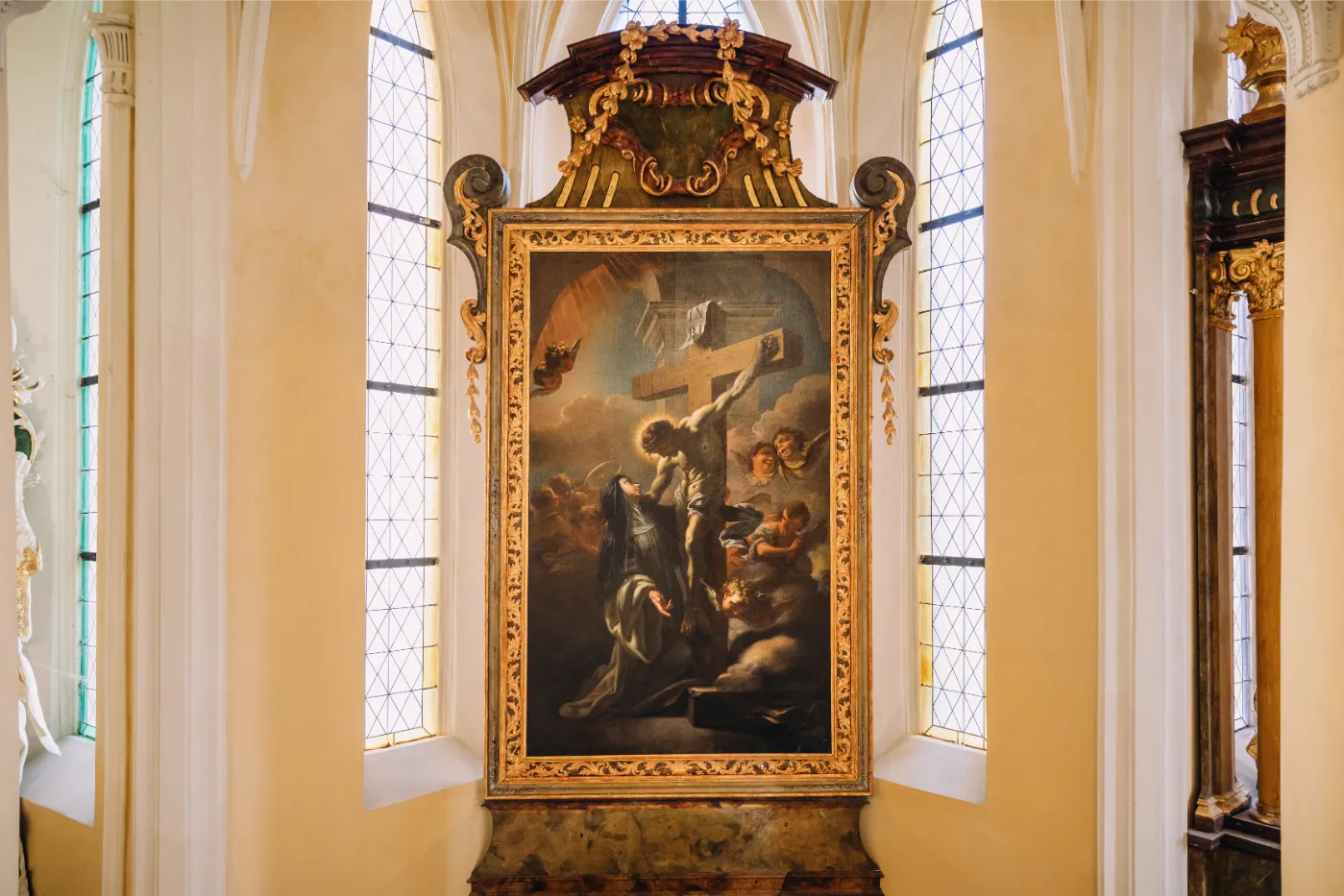
The Vision of St Lutgardis by Petr Brandl, from around 1729 – St Lutgardis was a Dutch nun of the Cistercian Order. Brandl’s sketch of this painting became an inspiration for the sculptor Matyáš Braun, who created a sculptural group based on it on the thirteenth pillar of the Charles Bridge in Prague.
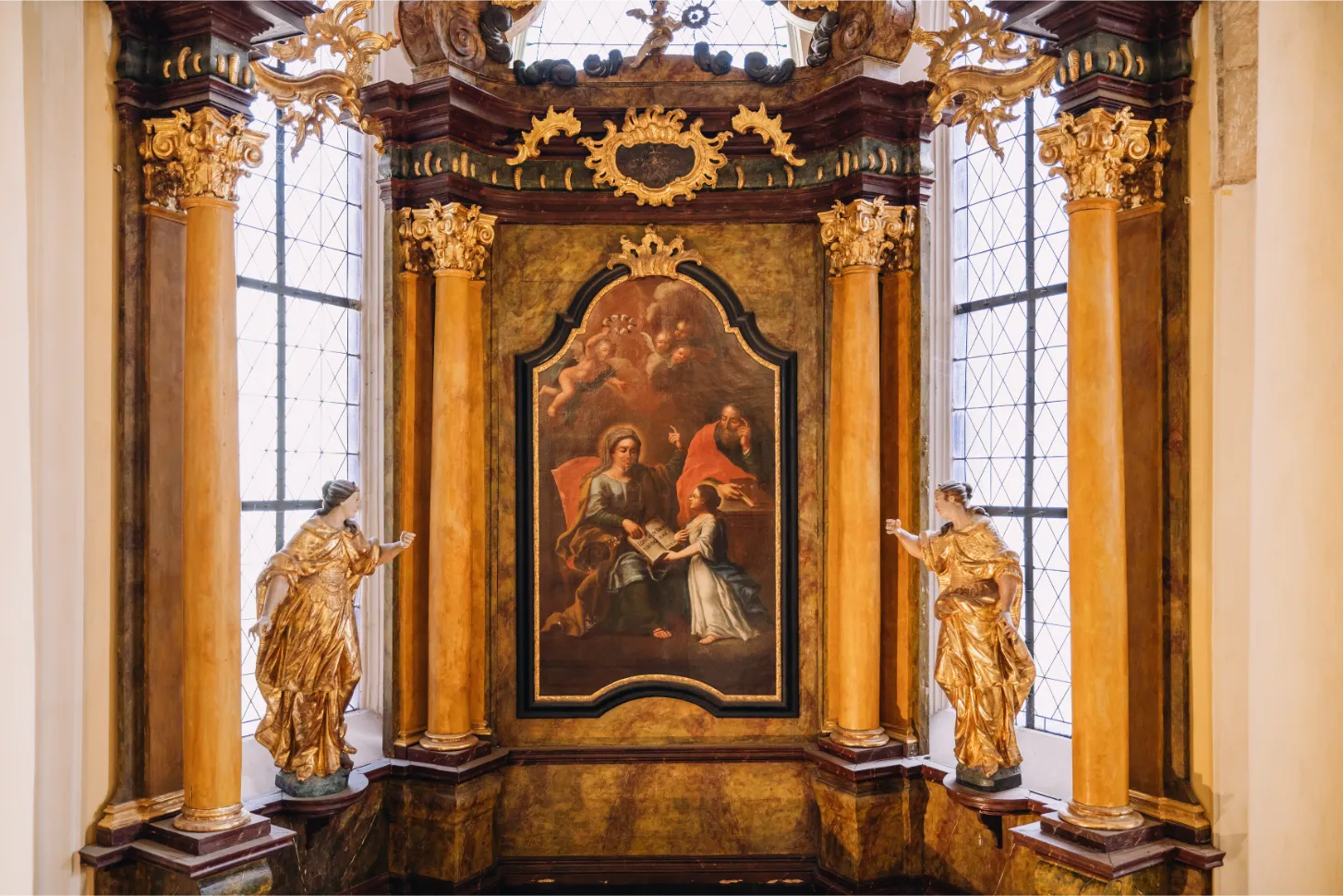
The Chapel of the Virgin Mary and a painting by Jan Quirin Jahn depicting the parents of the Virgin Mary – St Anne and St Joachim
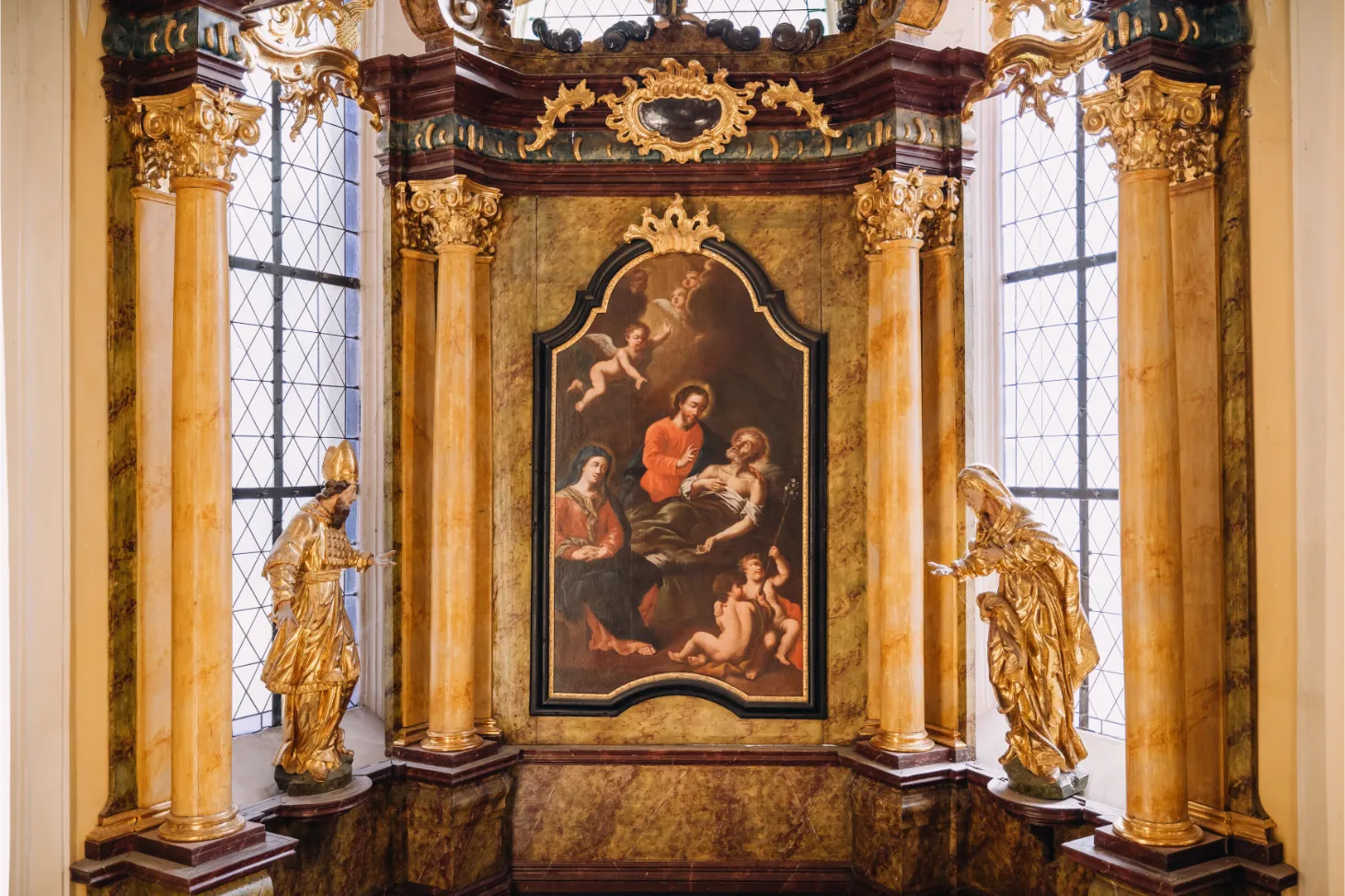
The Death of St Joseph by Gennaro Basili
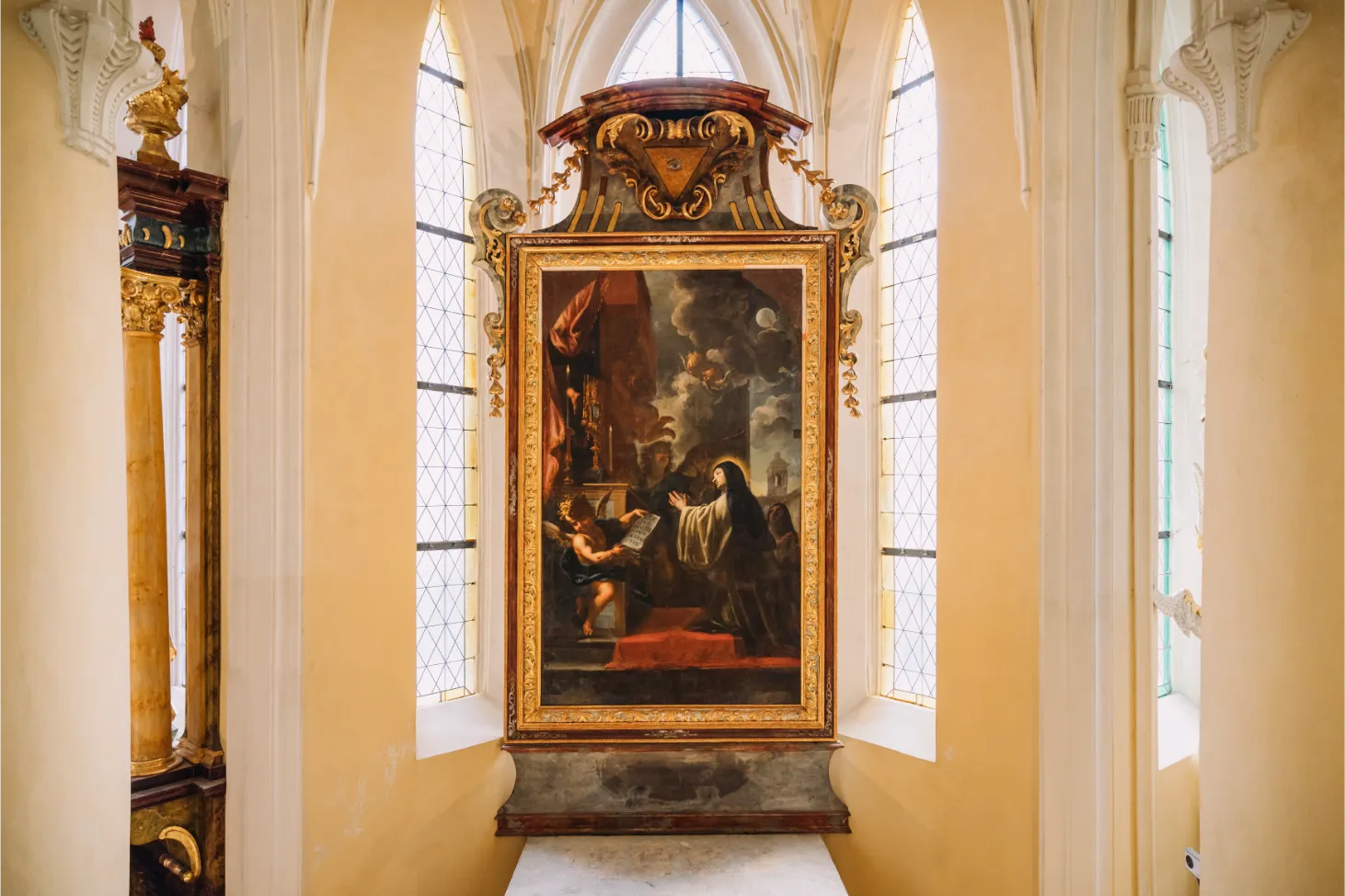
Painting of St Juliana of Liège by Petr Brandl from around 1729 – depicts St Juliana, portrayed as a Cistercian nun, kneeling in front of the monstrance of Sedlec.
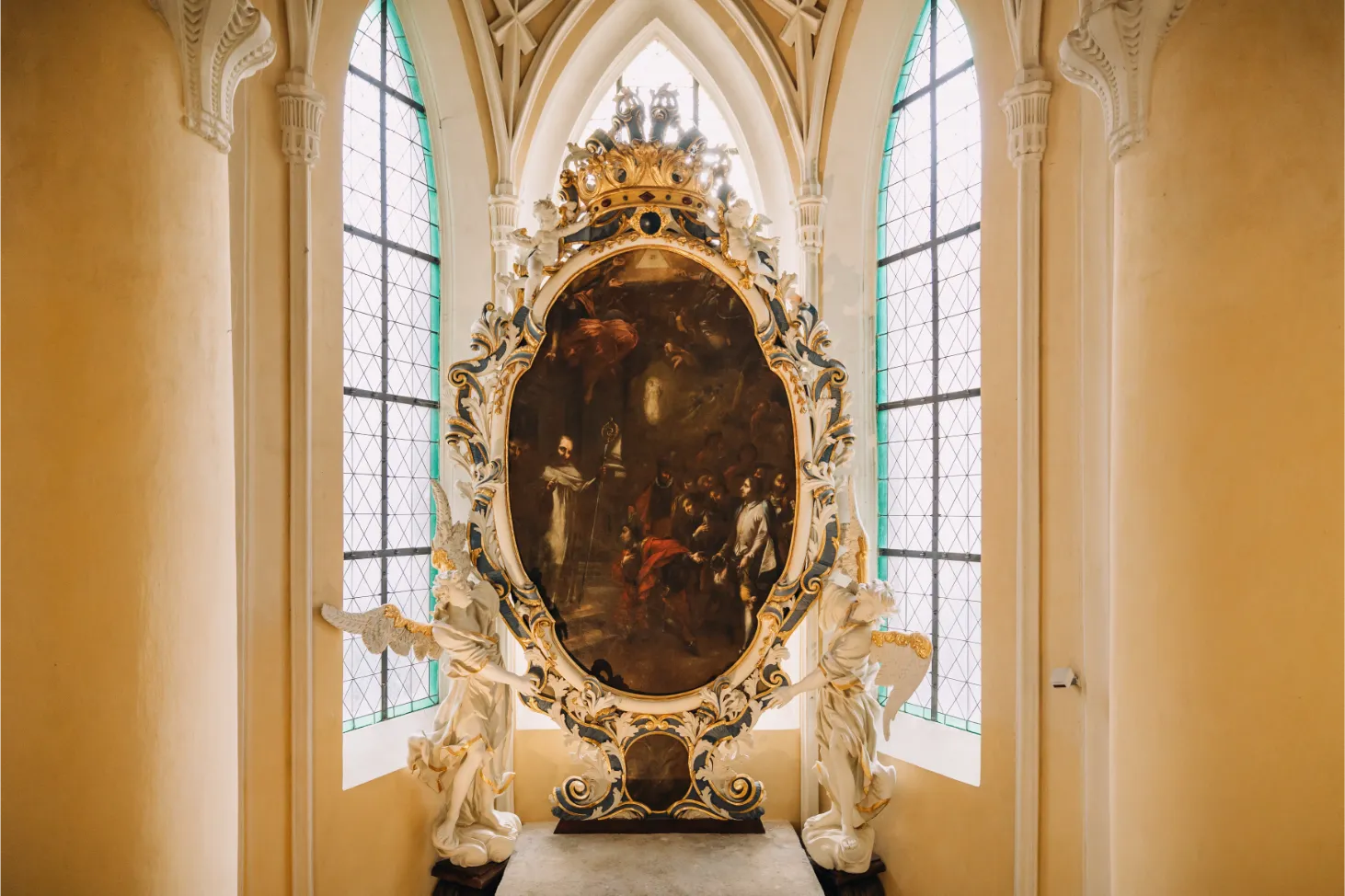
The Admission of the Young Bernard of Clairvaux to the Cistercian Order by Michael Leopold Willman – St Bernard of Clairvaux became the most prominent figure of the Cistercian Order. He lived from 1090 to 1153 and was a distinguished theologian and mystic, as well as an adept preacher, diplomat, and writer. For example, he wrote down the rules of the Order of the Knights Templar. He influenced Christian spirituality for centuries.
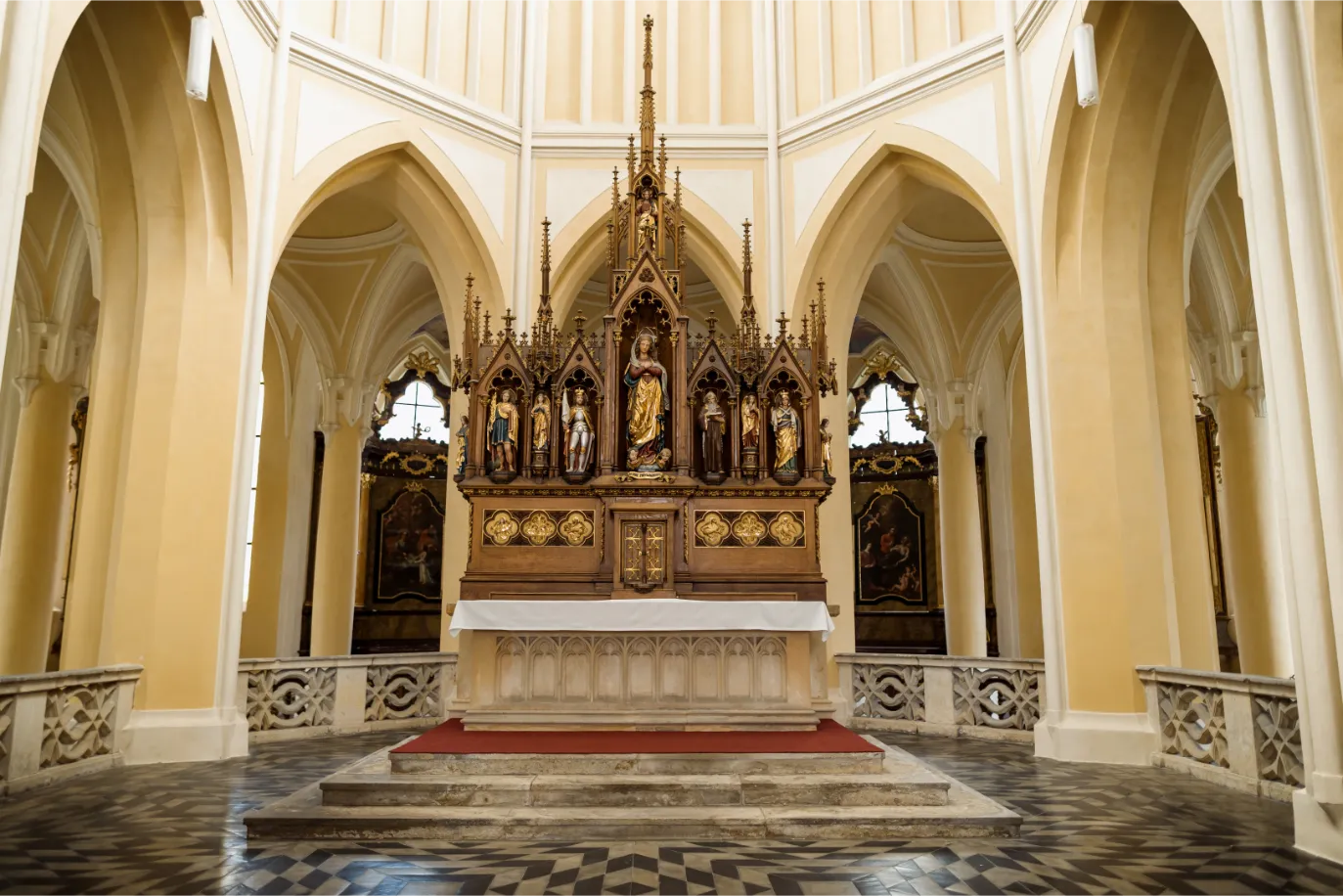
The presbytery
This is the place where the priest does his work. It is the most sacred part of the church that is structurally expressed by its elevation,
fencing and decoration (execution of the paving). It is here that the Church, in worship, commemorates (and makes present) Christ’s
redemptive death on the cross.
The neo-Gothic main altar was created by Josef Krejčík in 1912. The floor of the presbytery is covered in authentic tile with original
intertwining patterns, designed by Santini-Aichel. During the restoration in the Baroque period, a crypt was built under the presbytery for
burials of the abbots of Sedlec.
The Cathedral of the Assumption is the parish church of the parish of Kutná Hora – Sedlec. Regular services are held in the cathedral,
either in the main nave or in the side chapel, which is not normally open to the public.
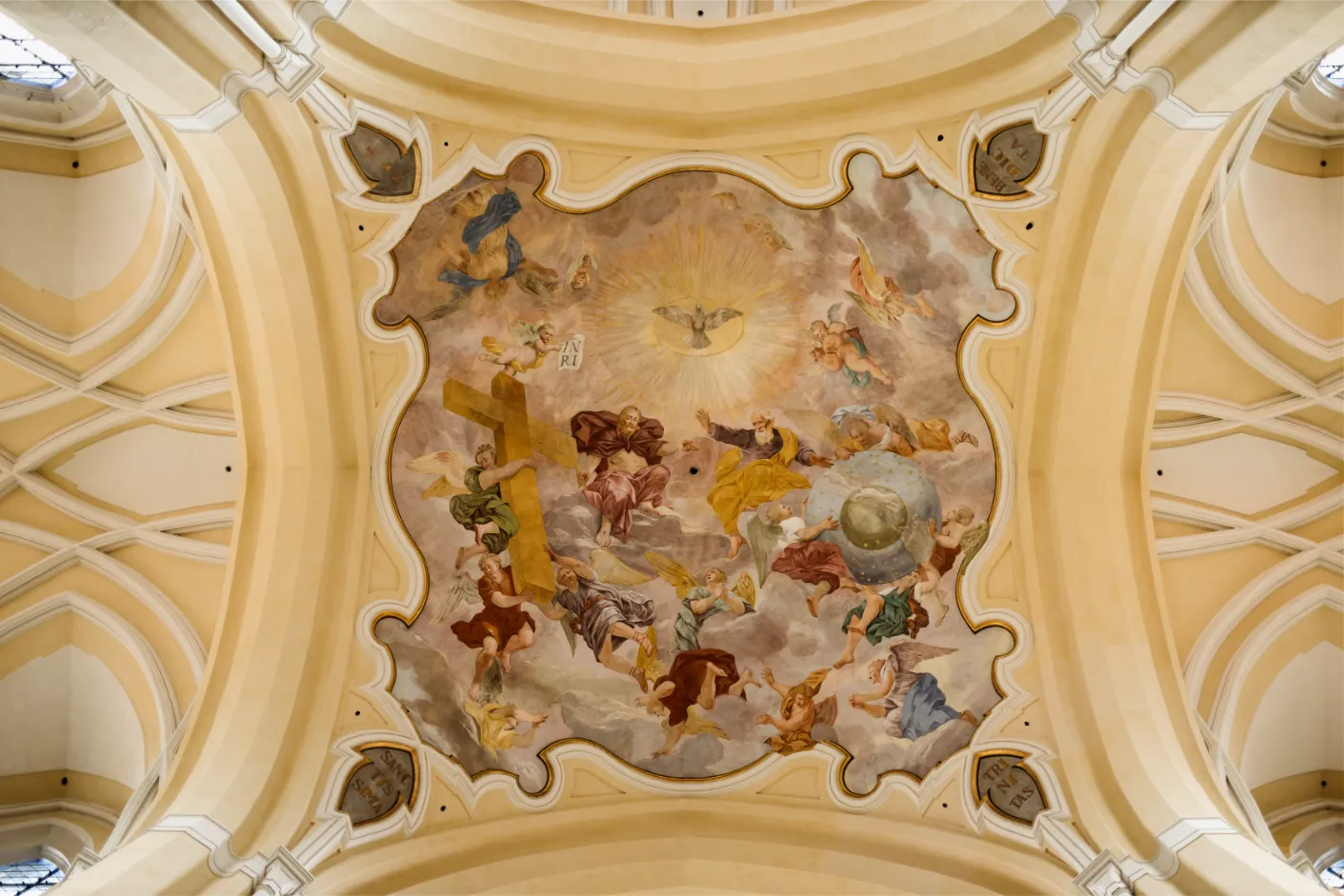
The fresco in the transept – at the point where the transept crosses the nave, there is a painting of the Holy Trinity by Jan Jakub
Stevens of Steinfels on the ceiling in the dome. The Holy Trinity depicts three divine persons—God the Father, God the Son (Jesus
Christ), and the Holy Spirit. It is one of the central mysteries of the Christian faith revealed by Jesus Christ, namely, that there is one
God that lives in three persons.
Jan Jacob Stevens of Steinfels (1655-1730) was a member of the Stevens family of Dutch painters. His grandfather, Pieter Stevens,
was a court painter to Emperor Rudolf II. It is likely that Jan Jakub was initially active in Italy, where he found inspiration in the works of
Pietro da Cortona and Giovanni Lanfranco. He created most of his works in the 1690s. The fresco in the Sedlec Cathedral was painted in 1705.
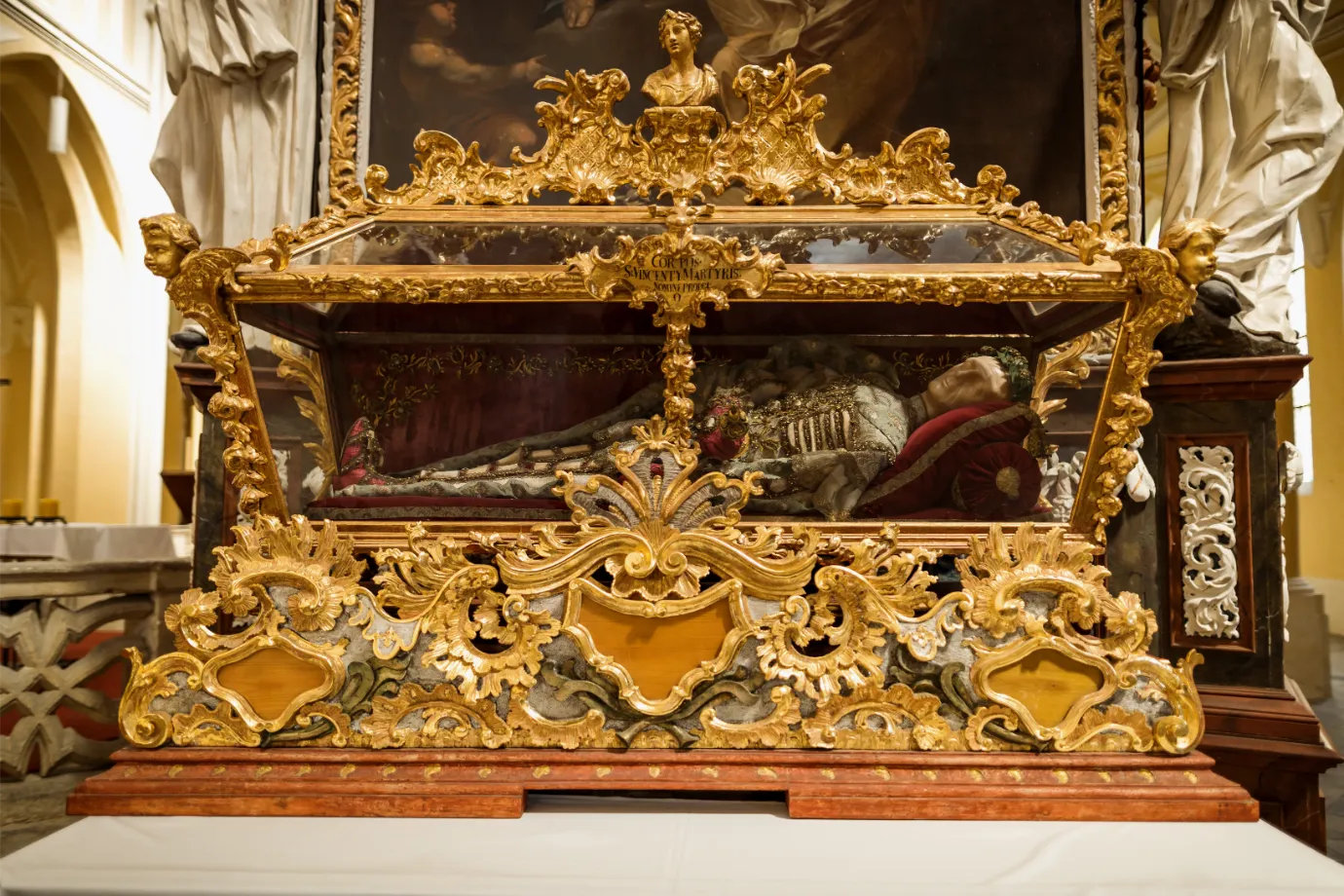
The reliquaries of St Vincent (on the right) and St Felix (on the left) contain extremely rare relics of Roman martyrs that lived in the
2nd century. The relics were donated to the cathedral by Pope Benedict XIV. in 1762 for the 600th anniversary of its consecration. They
are displayed on figurines, secured in place with wax.
In the Middle Ages, relics were one of the most important elements of Christian devotion. Having relics in churches was seen as a
tangible bond between heaven and earth. It was believed that saints were in the presence of God and could intercede for people. To
have their relic meant to have an intercessor ‘close by’.
The painting on the right by Jan Kryštof Liška, dating from the late 17th century, depicts St Bernard being nourished with wisdom from
the Virgin Mary’ breast. On the left is the Last Holy Communion of St Benedict. St Benedict lived from 483 to 543 and was the founder
of Western monasticism, from which the Cistercian Order emerged.
Jan Kryštof Liška (1650–1712)
He was born into the Moravian noble family of the Knight Liška of Rottenwald. After his father’s death, Jan’s mother remarried Michael L.
Willmann, who was a painter. The young Liška was very close to his stepfather and apprenticed in his workshop between 1664 and
1670. From 1689 Liška worked mainly in Prague, where he had disputes with the painters’ guild. At the same time, he remained in the
artistic shadow of his more famous stepfather.
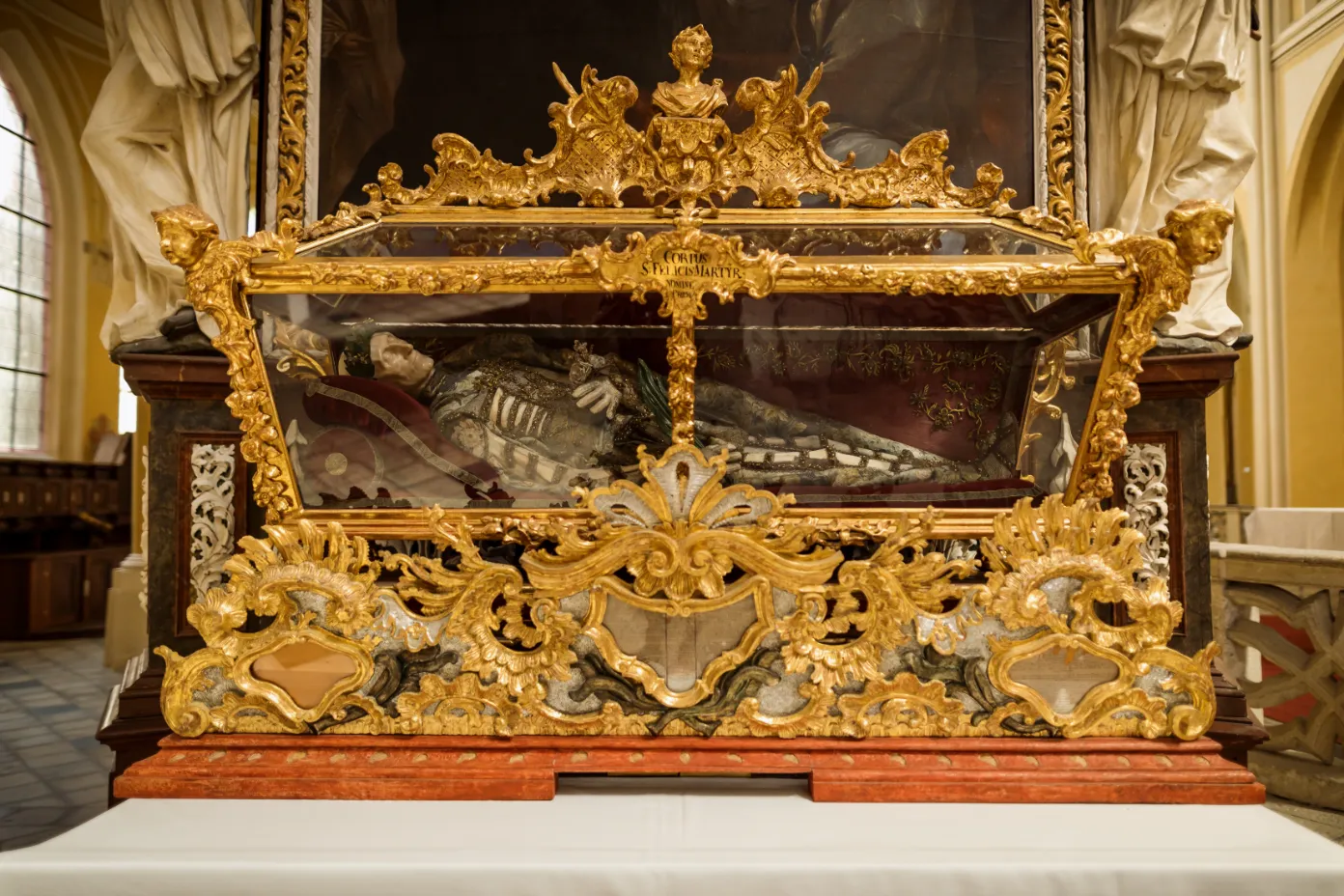
The reliquaries of St Vincent (on the right) and St Felix (on the left) contain extremely rare relics of Roman martyrs that lived in the
2nd century. The relics were donated to the cathedral by Pope Benedict XIV. in 1762 for the 600th anniversary of its consecration. They
are displayed on figurines, secured in place with wax.
In the Middle Ages, relics were one of the most important elements of Christian devotion. Having relics in churches was seen as a
tangible bond between heaven and earth. It was believed that saints were in the presence of God and could intercede for people. To
have their relic meant to have an intercessor ‘close by’.
The painting on the right by Jan Kryštof Liška, dating from the late 17th century, depicts St Bernard being nourished with wisdom from
the Virgin Mary’ breast. On the left is the Last Holy Communion of St Benedict. St Benedict lived from 483 to 543 and was the founder
of Western monasticism, from which the Cistercian Order emerged.
Jan Kryštof Liška (1650–1712)
He was born into the Moravian noble family of the Knight Liška of Rottenwald. After his father’s death, Jan’s mother remarried Michael L.
Willmann, who was a painter. The young Liška was very close to his stepfather and apprenticed in his workshop between 1664 and
1670. From 1689 Liška worked mainly in Prague, where he had disputes with the painters’ guild. At the same time, he remained in the
artistic shadow of his more famous stepfather.
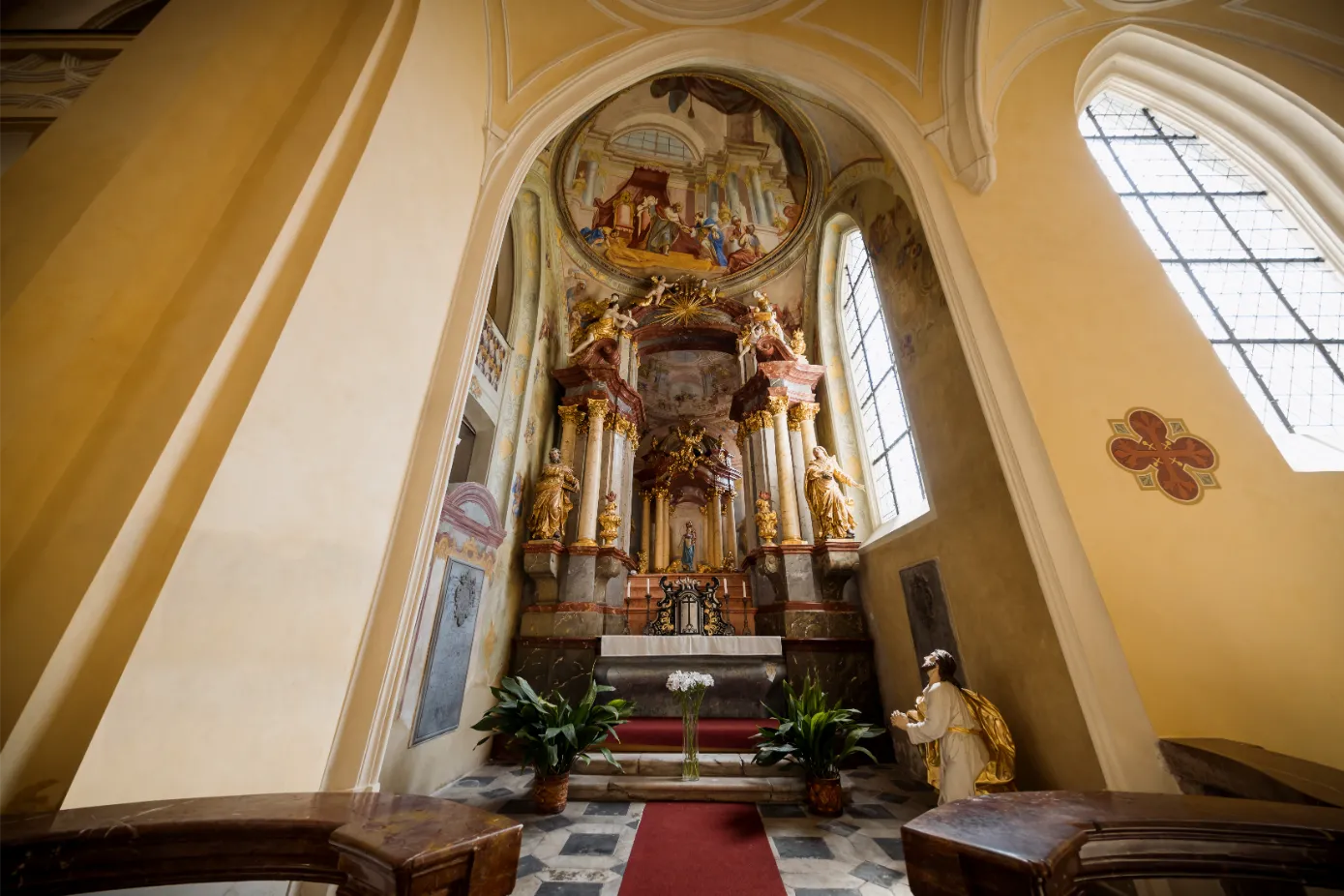
The Chapel of Our Lady of Sedlec dates from the second half of the 15th century. It is conceived as a two-altar chapel that, together
with the wall painting, creates a three-dimensional impression as if the chapel formed a separate nave of the cathedral. During the
cathedral’s Baroque renovation, the carver Juda Tadeáš Supper added Baroque features to the original Gothic statue of the Virgin. Wigs
were apparently placed on the statue’s head for various occasions. However, these have not been preserved, so the Virgin Mary of
Sedlec is currently bare-headed. The two altars in the chapel emphasize the special reverence that the Cistercians had for the Mother of God.
Who are the Cistercians? They are a monastic order founded in 1098. Their first monastery was founded in France, about twenty
kilometres from Dijon. It was called Cîteaux in French and Cistercium in Latin. The main mission of the Cistercians is to deepen the
relationship with God, to pray and to search for the meaning of life. That being said, however, they also work hard. They live by the
motto ‘Ora et labora’ meaning ‘Pray and work’. Paradoxically, due to its strict ideals and the great popularity of one of the first abbots,
Bernard of Clairvaux, the Cistercian Order spread quickly throughout Europe. Over the first century of its existence, roughly five hundred
monasteries were established, approximately five per year. The Cistercian monastery of Sedlec, founded in 1142, was their first
monastery in what is now the country of Czechia.
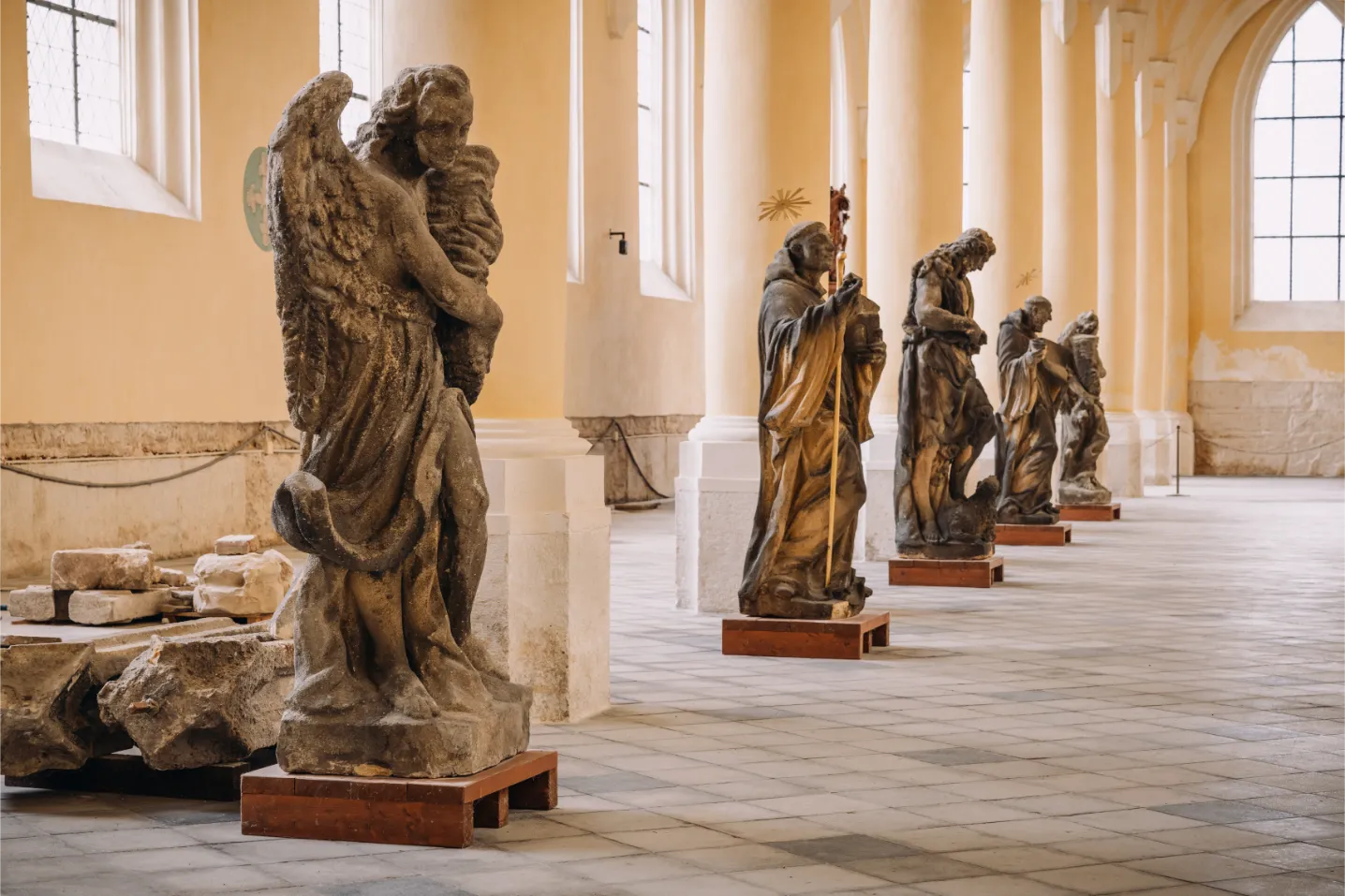
Statues from the west front of the cathedral
These statues by Matěj Václav Jäckel originally decorated the facade of the cathedral. Two angels with the horns of plenty stand on
either side, and on the left is St Benedict holding his monastic rule and a cracked chalice. The monastic rule represented not only the
totality of the rules by which the religious order lives, but above all the spiritual and moral framework for this life. The second statue
portrays St John the Baptist with a lamb at his feet. The last of the trio of statues is that of Robert of Molesme with a shepherd’s staff and
a monastery.
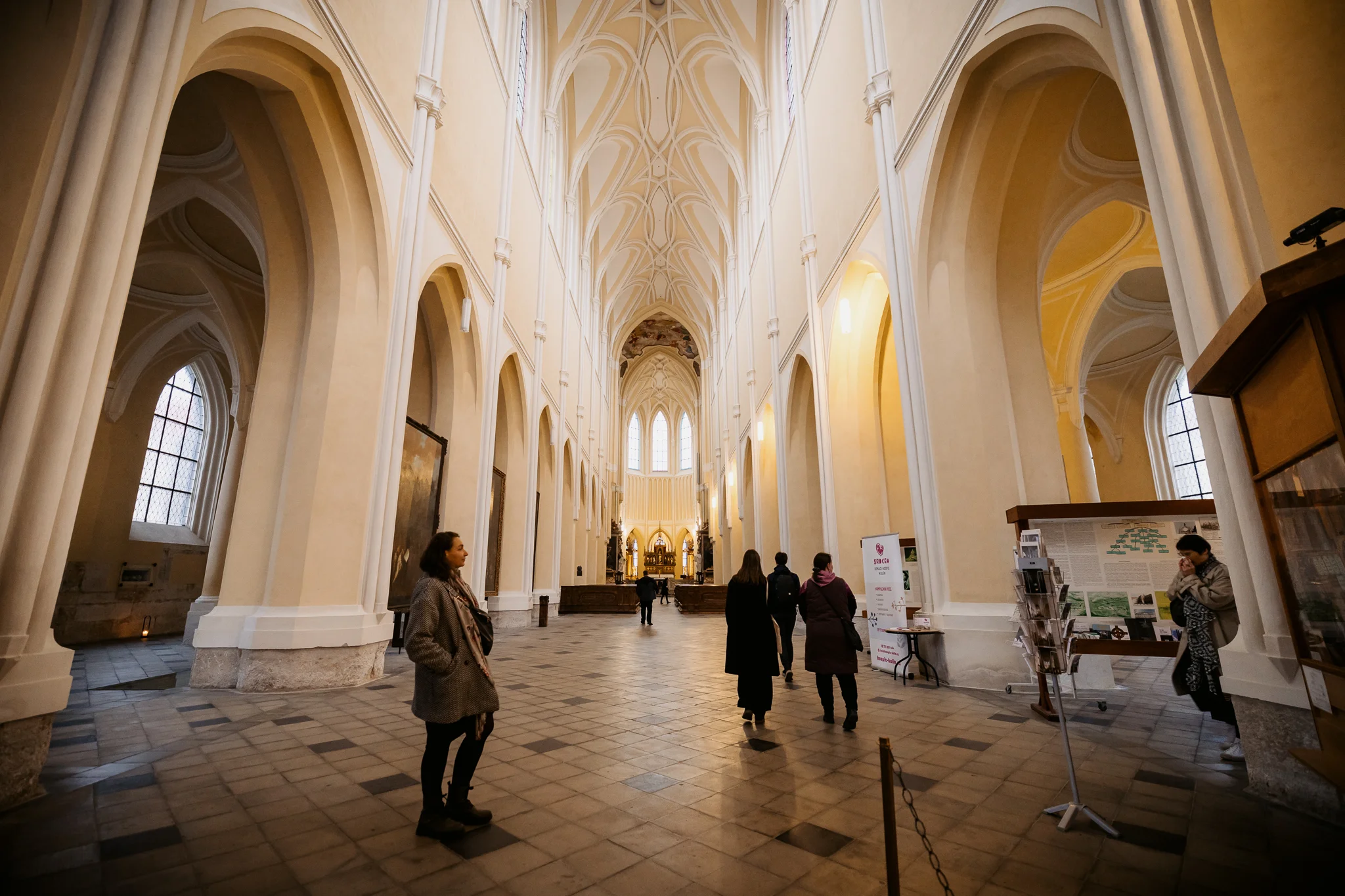
Welcome to the Cathedral of the Assumption of the Virgin Mary and St John the Baptist, an active Roman Catholic church where regular services are held. At the same time, you are standing in the oldest cathedral structure in the present-day Czech Republic, a site of outstanding uniqueness that has been inscribed on the UNESCO World Heritage List since 1995.
Tickets to Sedlec sights can only be purchased online or at the Sedlec Information Centre, 279 Zámecká Street.
9 AM - 4 PM
150 CZK / adult

